USDT vs. USDC in 2026: Liquidity vs. Counterparty Risk — Analyst Report
Why Stable coin Safety Is No Longer a Binary Choice
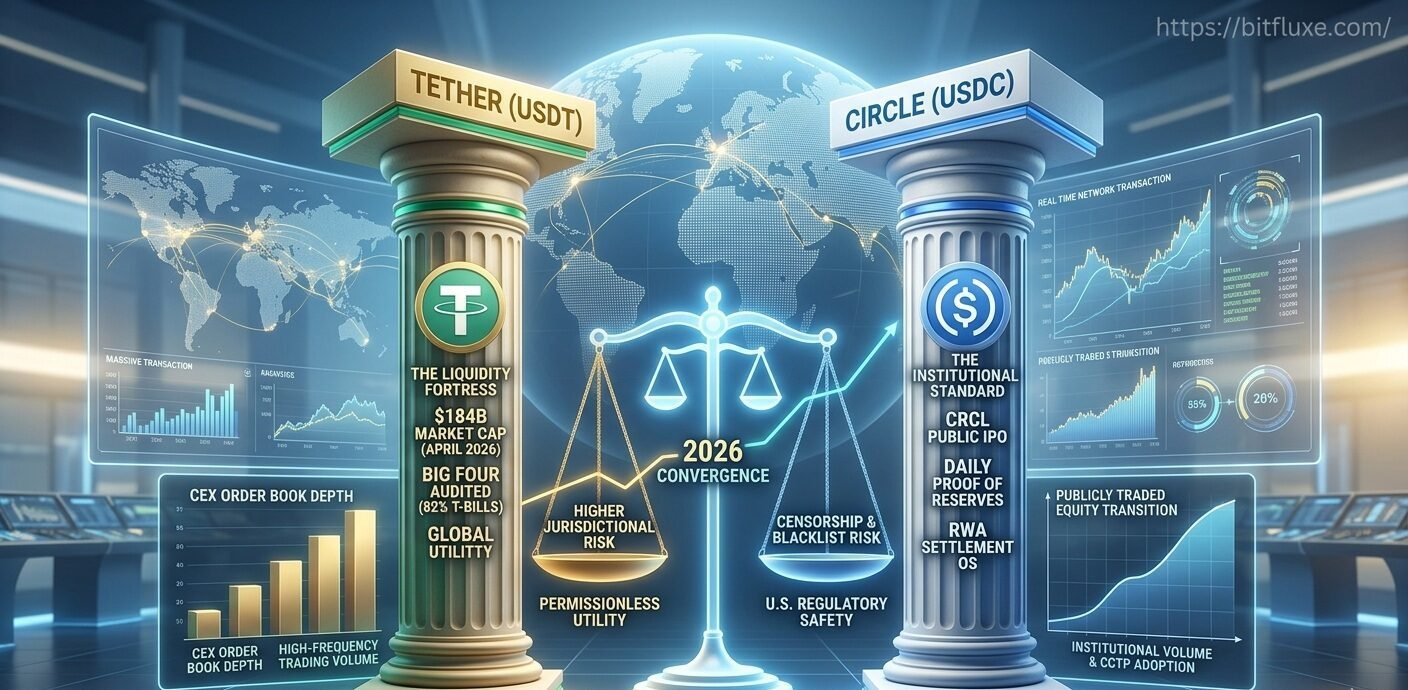
Most people think USDC is safe and USDT is risky. The reality is that the $250 billion stablecoin market has matured into a sophisticated tug-of-war where “safety” depends entirely on which side of the regulatory fence you stand on. While Tether (USDT) maintains its grip on the massive liquidity pools of the Global South, Circle’s USDC has effectively become the official dollar-on-a-chain for Western institutional finance.
Wait — this part matters.
The data tells a different story than the headlines of 2023. Back then, USDC depegged during a banking crisis, and USDT was a “black box” of offshore commercial paper. Today, in April 2026, Tether has engaged KPMG — one of the Big Four accounting firms — for its first-ever full financial statement audit. Meanwhile, Circle completed its IPO in June 2025 on the NYSE under ticker CRCL, turning USDC into the product of a publicly traded, SEC-regulated company.
And honestly? That surprised me too.
The Tether (USDT) Fortress: Liquidity at Scale
Liquidity is Tether’s ultimate weapon. Even as new U.S. stablecoin regulation tightens under the GENIUS Act, USDT remains the primary vehicle for high-volume trading across the TRON and Ethereum networks. Traders value the fact that $1 million in USDT can be swapped with virtually zero slippage on almost any exchange, anywhere in the world.
The depth is staggering.
│ QUICK ANSWER │
│ Is USDT safe to hold in 2026? │
│ │
│ Yes, for most users. Tether announced │
│ on March 24, 2026 that KPMG has been │
│ hired for its first full audit of ~$185B│
│ in reserves. However, USDT still carries│
│ higher jurisdictional risk for │
│ U.S.-based entities compared to USDC. │
Here’s the critical update most people are missing: Tether previously relied on monthly attestations from BDO Italia — a far more limited process than a true audit. The KPMG engagement, announced March 24, 2026, covers assets, liabilities, internal controls, and the systems tracking roughly $184–185 billion in reserves. This is not an attestation. It is a full financial statement opinion — the same standard applied to publicly listed banks.
Most people miss this completely, focusing only on where Tether is headquartered rather than the actual strength of the balance sheet.
Real talk: Tether is the king of utility, and it’s now closing the transparency gap.
Lessons from the Bitfluxe Trading Desks
At Bitfluxe, we’ve had a front-row seat to how these theoretical risks play out in the real world. I vividly remember the chaos of March 2023. When Silicon Valley Bank collapsed, the resulting USDC depeg triggered a massive wave of panic. On our platform, we saw a sudden, aggressive migration of users shifting their capital into USDT. At that moment, the narrative of “regulated safety” fell apart, and Tether’s raw liquidity became the only lifeboat that actually worked. It was my first true “lightbulb moment”: I realized that in a crisis, liquidity and safety are two entirely different animals.
Fast forward to April 2026, and the cycle is repeating in a fascinating way. Following the recent KPMG audit news, we are seeing our community members move back toward USDT with renewed confidence. The pattern we consistently observe at Bitfluxe is that while institutional users prefer the legal comfort of USDC’s IPO status, the active retail traders—the ones moving money daily—always gravitate toward where the volume is. In the end, a stablecoin is only as good as your ability to exit it, and our data shows that when the market gets volatile, Tether’s “fortress of liquidity” still wins the trust of the street.
What the KPMG Audit Actually Covers
The audit scope goes beyond prior reserve snapshots. KPMG will review Tether’s asset composition, debt exposure, and risk management systems. Tether has also separately engaged PwC to modernize its internal reporting infrastructure ahead of the audit — a move that signals this is a structural shift, not a PR exercise.
USAT: Tether’s U.S. Play
Tether has also launched USAt — a federally regulated stablecoin issued via Anchorage Digital Bank, designed specifically for the U.S. market under GENIUS Act compliance. This product is audited by Deloitte through its Anchorage partnership, giving Tether a compliant onshore product while USDT continues to dominate offshore volumes.
Why 550 Million Users Still Choose USDT
With over 550 million users globally, USDT’s network effect on TRON is unbreakable for now. TRON’s low fees and high speed have made it the preferred rails for remittances across Southeast Asia, Africa, and Latin America. Circle has invested heavily in Solana and Base to compete, but has not dented TRON’s dominance in those regions.

The Circle (USDC) Evolution: From Token to Public Equity
Circle is now a public company. After completing its $1.2 billion IPO on the NYSE in June 2025 under ticker CRCL, Circle subjects its reserves to SEC-level oversight. Every quarter, the company files 10-Q reports. Every year, a 10-K. Its auditor is Deloitte & Touche LLP, ratified by shareholders for the 2026 fiscal year.
This is where it gets interesting.
Despite having a smaller market cap than USDT, USDC has surged in institutional adoption. According to Circle’s own 2025 annual data, USDC on-chain transaction volume climbed 384% year-over-year to $33.3 trillion. Institutional players like BlackRock use USDC for real-world asset (RWA) settlement precisely because the counterparty risk is tied to a regulated U.S. entity with public filings. Think about it this way: if you are a corporate treasurer, you don’t care about “vibes” — you care about legal recourse.
Nobody talks about this enough.
Circle Payments Network: The Infrastructure Play
Circle launched its Circle Payments Network (CPN) in May 2025 with over 100 financial institutions in the pipeline. This positions USDC not just as a trading stablecoin but as the settlement layer for institutional money movement — a market USDT has never seriously competed in.
The Cost of Going Public
Here’s the other side. Circle reported a $70 million net loss for full-year 2025, heavily impacted by $591 million in IPO-related non-cash charges. Its revenue is 95% interest income from Treasury bill yields — meaning if rates drop, Circle’s business model takes a direct hit. Being public means this information is available to everyone, including its competitors.
Side-by-Side: Counterparty Risk vs. On-Chain Liquidity
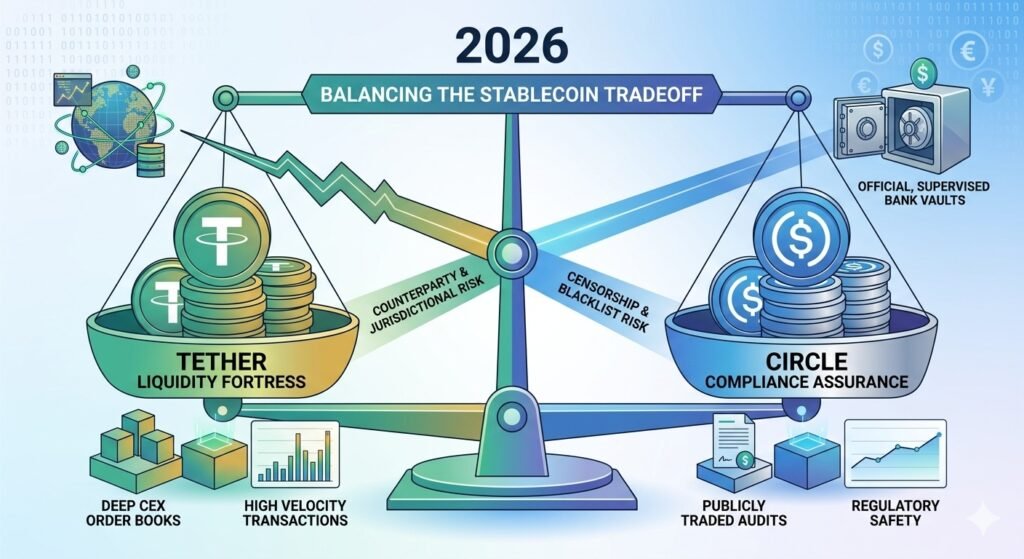
Risk has two distinct faces here. One is the risk that the money isn’t there (Solvency), and the other is the risk that you can’t access it (Censorship). Tether has moved to prove its solvency through the KPMG engagement, but because it operates outside the U.S. perimeter, it is less likely to freeze assets at the whim of a single Western court.
USDC offers the opposite profile.
| Metric (April 2026) | Tether (USDT) | Circle (USDC) |
|---|---|---|
| Market Cap | ~$185 Billion | ~$61–78 Billion |
| Primary Backing | U.S. T-Bills + Bitcoin/Gold | 100% Cash/T-Bills |
| Audit Status | KPMG engaged (first full audit in progress) | Deloitte (ongoing, public company) |
| Regulatory Status | Offshore / MiCA Compliant / USAT for U.S. | NYSE-listed / SEC-regulated / MiCA Compliant |
| Top Network | TRON / Ethereum | Solana / Base / Ethereum |
| Transaction Volume | Dominant on CEXs | $33.3T on-chain (2025) |
| U.S. Restrictions | Potential under GENIUS Act | Fully compliant |
This is debated — and I go back and forth on it. While USDC is “safer” from a legal standpoint, the centralized nature of a public company means your funds could be blacklisted faster than you can say “compliance.” On the other hand, USDT’s offshore status makes it the preferred tool for those who prioritize permissionless movement over state-sanctioned safety.
Check the current peg stability of both in real-time using the Bitfluxe Crypto Converter Tool.
Does Your Portfolio Need “Offshore” or “Onshore” Stability?
Your choice depends entirely on your goal. If you are day-trading on global exchanges or moving capital across Southeast Asia, the Middle East, or Latin America, USDT is the only logical choice due to its sheer network depth. However, if you are building a long-term treasury, settling RWA transactions, or operating within DeFi protocols on Solana or Base, USDC is the architecturally superior fit.
I could be wrong here, but a convergence is coming.
Tether has launched USAt for the U.S. market, directly attempting to compete in Circle’s regulated lane. Meanwhile, Circle is expanding its Cross-Chain Transfer Protocol (CCTP) to make moving USDC between chains as frictionless as a bank transfer. The gap between these two products is narrowing fast. Use a Crypto Profit Calculator to model your exposure during these shifts — the “safety premium” you pay in lower yield or higher fees for USDC is a real, quantifiable cost.
The Regulatory Tipping Point: GENIUS Act and What It Changes
The GENIUS Act — now signed into U.S. law — requires full audits for stablecoin issuers holding more than $50 billion in liabilities. Tether, with $185 billion in circulation, falls squarely in this category if it enters the U.S. market at scale. This is exactly why the KPMG engagement and USAt launch happened simultaneously.
For USDC, the GENIUS Act is a tailwind, not a headwind. Circle built its entire business model around regulatory compliance. Every new rule tightens the space around Tether and expands the moat around Circle.
Nobody should underestimate this shift.
Operationalizing the Data: Your 2026 Stablecoin Strategy
Start by auditing your own perimeter. If you live in a jurisdiction with strict capital controls — or if you simply move money across borders — USDT’s neutrality and liquidity are your greatest assets. For those in the EU, U.S., or UK who need to interact with DeFi protocols or institutional platforms, USDC’s regulatory clarity and transparent reserves are indispensable.
For a deeper breakdown of reserve risks, read the full USDT vs USDC 2026 Guide and the Is USDT Safe 2026 analysis on Bitfluxe.
Don’t put all your eggs in one basket.
│ QUICK ANSWER │
│ Which stablecoin has more liquidity? │
│ │
│ USDT leads in raw CEX order book depth │
│ and total market cap. USDC leads in │
│ institutional payment velocity — its │
│ on-chain volume hit $33.3 trillion in │
│ 2025, a 384% increase YoY. For trading: │
│ USDT. For settlements: USDC.
Smart positioning in 2026 considers a split approach — using USDT for active trading liquidity while keeping a portion in USDC as a regulated “exit ramp.” Always verify the latest reserve data before making any six-figure move. The Gold Price Analysis on Bitfluxe provides additional context on how macro dollar moves affect both stablecoins.
Stability is no longer a given — it’s a strategy.
FAQ
1. Can the U.S. Government shut down Tether in 2026?
The U.S. cannot directly shut down Tether since it operates offshore, but the GENIUS Act gives the Treasury significant leverage. The government can pressure U.S.-linked banks to restrict Tether-related transactions. This wouldn’t immediately kill USDT, but it would likely cause liquidity migration toward USDC. Tether’s USAt launch is a direct attempt to get ahead of this risk.
2. Is USDC more transparent than USDT right now?
Yes, structurally. Since Circle’s NYSE IPO in June 2025, the company files quarterly 10-Q and annual 10-K reports with the SEC, audited by Deloitte. Tether’s KPMG audit was only announced in March 2026 and has not yet been completed or published. Once KPMG’s full opinion is released, the transparency gap will narrow significantly — but as of April 2026, Circle’s disclosure framework is more mature.
3. Why does USDT still dominate the TRON network?
TRON’s extremely low fees — often under $1 — and fast confirmation times made it the preferred infrastructure for USDT transfers in developing markets. Tether’s early integration created a network effect that USDC has not broken despite Circle’s investment in Solana and Base. For users sending $200 across borders, TRON + USDT remains unbeaten on cost.
4. Does the gold price affect these stablecoins?
Not directly, but both are frequently used as the dollar on-ramp for commodity trades. Many investors use USDT to hedge against dollar inflation while tracking Gold Price movements on Bitfluxe. The irony is that both stablecoins are pegged to the very dollar that gold is used to hedge against.
5. What is “Counterparty Risk” in simple terms?
It’s the risk that the entity holding your backing won’t deliver when it matters. For USDT, the counterparty is Tether Ltd — an offshore private company until its KPMG audit is complete. For USDC, it is Circle Internet Group — a publicly listed U.S. company with SEC obligations. If either faces insolvency, your tokens could lose their peg. The key difference: Circle’s obligations are legally enforceable in U.S. courts. Tether’s are not — yet.

Hi, I’m Baber! I’m a blogger and crypto enthusiast dedicated to uncovering the best trading key levels in the financial markets. My mission is to break down advanced technical analysis tools into easy-to-follow guides for traders worldwide. When I’m not analyzing charts on TradingView, I’m busy researching the latest in blockchain security and SEO strategy to bring you the most accurate market updates.
View full details on our Terms and Conditions page.