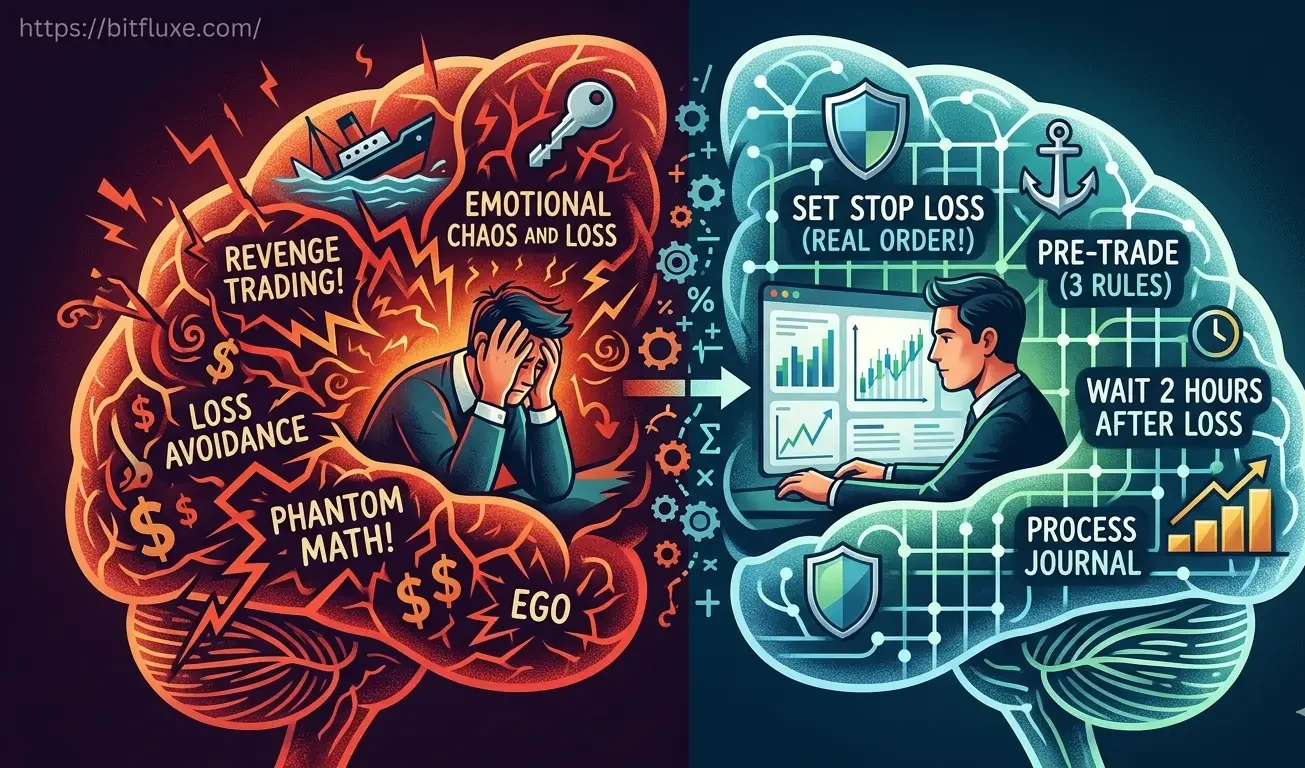
Trading Psychology Mistakes That Blow Retail Accounts
Ninety percent of retail traders lose money because of Trading Psychology Mistakes That Blow Retail Accounts And the Fixes That Actually Work. Not because they picked the wrong indicator. Not because they missed an earnings report. Because their brain worked exactly as it was designed to, and the market punishes that.
Here’s something most trading educators won’t say out loud: the psychological mistakes retail traders make aren’t character flaws. They’re wiring. The human brain wasn’t built for financial markets. It was built for survival. And survival instincts, avoid loss, act fast, follow the herd, are precisely the behaviors that drain trading accounts .I’ve tracked these patterns across years of watching retail traders in gold, crypto, and forex markets. The technical mistakes are almost never what finish people off. It’s always the psychology. Every single time.
These six trading psychology mistakes show up in blown accounts across every asset class, every time zone, and every experience level. More importantly, each one has a fix that doesn’t require willpower, because willpower doesn’t work under live market pressure.
What causes most retail traders to blow their accounts? Research from behavioral finance consistently shows that emotional decision-making accounts for the majority of retail trader failures, far outweighing technical incompetence. The six core psychological mistakes are: refusing to accept losses, intolerance of uncertainty, oversizing after early wins, tying identity to outcomes, revenge trading, and overconfidence. Each has a structural fix that removes emotion from the decision at the critical moment.
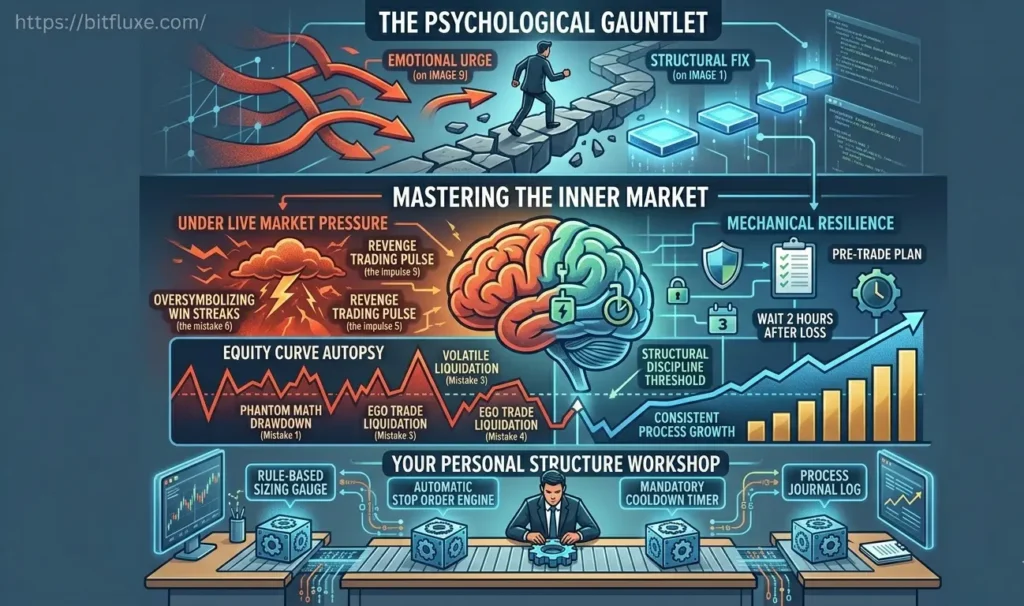
Mistake 1: The Loss Doesn’t Feel Real Until You Close the Trade
This is the single biggest account killer in retail trading. Not greed. Not overleveraging. The refusal to accept a loss as real until you actually click sell.
Runbo Li, CEO, Magic Hour AI, calls it phantom math. Traders mentally calculate their P&L from their entry price instead of from where the market actually is right now. The position is underwater. Everyone can see it. But closing it feels like a verdict on their intelligence, so they hold. And the hole gets deeper.
Li has watched this pattern destroy people far outside of markets too. A family friend in his community put a significant chunk of savings into a single stock based on a tip. It dropped 15%. He said he’d sell at breakeven. It dropped 30%. Same answer. By the time he finally sold, he’d lost over half his position. The original 15% loss was painful but survivable. What actually happened changed his family’s financial trajectory for years.
What went wrong wasn’t a knowledge gap. He understood risk in theory. The problem was emotional accounting. Humans process unrealized losses and realized losses in completely different parts of the brain. An unrealized loss feels like a maybe. A realized loss feels like a final answer about who you are. So people avoid the answer until the maybe becomes a catastrophe.
Stop losses aren’t failure — they’re the subscription fee for staying in the game.
The reframe matters too. Every blown account has the same autopsy: a small manageable loss that someone let compound because they couldn’t separate their identity from their position. Your net worth is not your self-worth. The moment you actually internalize that, you stop making desperate trades to prove you were right and start making calculated ones to build something real.
Track your live levels against actual support zones using the real-time gold price tools on Bitfluxe to set stops based on market structure, not on what number would make you feel okay about the loss.

Mistake 2: You Can’t Sit With Not Knowing What Happens Next
This one surprises people when I frame it as psychological rather than technical. Wayne Lowry, Interim CEO of Sunny Sunny Glen Children’s Home , put it in terms that immediately clicked. He works daily with young people who act on impulse, and the root cause is almost always identical: they can’t tolerate the discomfort of sitting with uncertainty. When something moves against them, the emotional response becomes overwhelming. Their brain screams to do something right now, anything to resolve the tension.
When a position moves against a retail trader, the same mechanism fires. The brain registers uncertainty as threat. The emotional response is to double down to recover losses, or close a winning trade way too early because the gain feels fragile. Neither response is based on analysis. Both are based on the need to end the discomfort of not knowing.
Lowry’s fix isn’t more chart study. It’s building a system that removes the decision from the emotional moment entirely. His team at Sunny Glen doesn’t ask a teenager in the middle of a meltdown to calmly decide what to do next. They’ve already agreed on a plan beforehand, and the plan is what they follow when emotions run high.
For traders, that means writing down your entry, your stop loss, and your take profit before you ever click buy. Then closing the platform and walking away. Not “watching but not touching.” Closing it. The traders who completely change their results don’t get smarter about markets. They stop letting their nervous system drive the keyboard.
┌──────────────────────────────────────────────────┐
│ 💡 Pro Tip: The Pre-Trade Write-Down │
│ │ │ Before any trade, write three things on paper: │
│ (1) exact entry price, (2) stop loss level and │
│ the structural reason for it, (3) take profit │
│ and why. If you can’t answer all three before │
│ clicking buy, the trade isn’t ready. This single │
│ habit eliminates most impulsive entries within │
│ the first two weeks of consistent practice. │
└──────────────────────────────────────────────────┘
Mistake 3: You Sized Up Too Fast After a Few Early Wins
You open a small account. You string together a few wins. Suddenly you’re convinced you’ve decoded something the market was hiding from everyone else. So you bump position size from 1% risk to 5%. Then 10%. One bad trade wipes three weeks of work. Instead of stepping back, you go on tilt and double down to get it back. And now you’re in a hole that takes months to climb out of, if the account survives at all.
Research from behavioral finance, documented across studies of retail brokerage accounts by Barber and Odean, found that the most active traders underperformed the market by 6.5% annually, not because of poor strategy selection but due to identifiable, recurring psychological errors around sizing and frequency. Winning streaks are actually the most dangerous period for retail traders. Not losing streaks. Winning streaks. Because they breed the overconfidence that causes oversizing, and oversizing is what actually kills accounts.
The fix is boring. Pick a maximum risk per trade, 1% to 2% of your total account, and treat it as a rule you don’t negotiate with yourself about. Write it down before you open the platform each session. If a setup looks so good that you want to “just this once” go to 5%, that’s your signal to stick to 1% even more firmly. The setups that feel irresistible are the ones with the most emotional contamination.
Keep a trade journal that tracks position sizing separately from P&L. Most traders who oversize don’t realize they’re doing it systematically until they see the pattern across 20 or 30 trades. Use the crypto profit calculator on Bitfluxe to build the habit of calculating exact risk before entering, the math done in advance is almost always more conservative than the math done in the middle of a compelling setup.
Mistake 4: You’re Trading Your Ego, Not the Market
When self-worth gets attached to trading results, every loss becomes a personal failure rather than a data point. Every profitable day feels like proof you’re smart. Every red day feels like evidence you’re not. And when you’re trading your self-esteem, risk management collapses, because cutting a loss means admitting you were wrong, and being wrong feels unbearable.
Think about it. The trader who adds to a losing position not because the thesis changed but because closing it means admitting a mistake. The one who shares only winning trades on social media and then takes reckless risks to maintain the image. The one who can describe every flaw in their entry in hindsight but couldn’t act on it in the moment because being right felt more important than being profitable.
The counterintuitive fix: stop journaling P&L and start journaling process. After each trade, answer three questions only: Did I follow my entry rules? Did I size correctly? Did I wait for my setup? If yes to all three, it was a good trade, regardless of whether it made money. If no to any of them, it was a bad trade, regardless of whether it happened to be profitable. A lucky trade that violated your rules is more dangerous than a stopped-out trade that followed them, because the lucky violation teaches you the wrong lesson about how markets work.
The traders who last in this market aren’t the ones who are always right. They’re the ones who stopped needing to be.
Mistake 5: Revenge Trading Feels Like Conviction, That’s What Makes It Lethal
Peter Signore, CEO, Dynaris has studied this pattern extensively through his own options trading and broader market analysis. A losing trade triggers the brain’s loss aversion response, which registers a financial loss as a threat rather than an information signal. The rational response is to step back and analyze. The emotional response is to immediately re-enter, often in a higher-risk instrument, often with a larger position, to recover the loss faster. The second trade isn’t placed based on analysis. It’s placed based on emotional urgency. And emotional urgency is the worst possible reason to enter a market.
Signore’s fix has two components. Both are structural rather than motivational.
First: a hard rule that no new position can be opened within a defined waiting period after closing a losing trade. He uses two hours. The waiting period interrupts the emotional feedback loop. It forces time between the loss event and the next decision, which is the only reliable way to let the rational brain re-engage before real money goes on the line again.
Second: every trade must be logged with the reason for entry before the trade is placed, not after. “I’m entering because the 15-minute structure broke above the previous swing high with volume confirmation” is a rational thesis. “I’m entering because I lost $400 on the last trade and need to get it back” reveals the emotional driver immediately. Traders who can’t articulate a pre-trade thesis that doesn’t reference their prior P&L are revenge trading, even if they don’t recognize it.
The neurological reality is uncomfortable but important: your brain genuinely cannot distinguish between the urgency of a real trading opportunity and the urgency of an emotional recovery impulse. They feel identical from the inside. The only protection is external structure, not willpower, structure.
Cross-reference your emotional state against real-time data at Bitfluxe’s live market tools before re-entering after a loss. If the chart isn’t giving you a new reason to enter, you don’t have one.
Mistake 6: Overconfidence After a Winning Streak Is When Accounts Actually Die
Here’s a counterintuitive truth most trading educators skip entirely: the most dangerous period in any trader’s career isn’t a losing streak. It’s a winning streak.
Losing streaks are painful. They force humility. They make traders review their process, tighten their rules, reduce position sizes. Winning streaks do the opposite. They create the illusion that the market has become predictable, that the trader has found an edge that doesn’t require the same discipline anymore, that the rules which applied to “old you” don’t quite apply to the version of yourself who just had six consecutive profitable trades.
And then the market delivers one session that erases weeks of gains.
I’ll be blunt: overconfidence dressed as conviction is what finishes most retail accounts that survive the early stages. Traders start needing to be right, so they size too big, trade too often, lean on leverage, and turn what would have been a normal losing trade into an account-threatening event. The fix is making risk completely mechanical: decide your max loss before entry, keep position sizes consistent regardless of recent performance, use hard exits, and review your process across dozens of trades rather than one hot streak.
The most useful mental model here is treating every new trading week as a fresh psychological start. The wins from last week are in the account. Good. They’re not a signal that the market owes you continued winning. The market doesn’t track your streak. It doesn’t know and doesn’t care that you’ve been on a run. Each setup either meets your criteria or it doesn’t, completely independent of everything that came before it.
Practically: after any winning streak of five or more trades, deliberately reduce position size by 25% for the next five trades. Force yourself to trade smaller when you feel most confident. This is counterintuitive. It’s also the only structural protection against the specific overconfidence that winning streaks reliably produce. For tracking your actual returns and keeping the math honest, run your numbers through the BTC to USDT converter on Bitfluxe to stay grounded in what you’ve actually made versus what it feels like you’ve made.

Why These Six Mistakes Always Appear Together
Wait. There’s something that gets missed when these mistakes are treated as separate problems.
They compound each other. Phantom math (Mistake 1) leads to larger unrealized losses, which triggers the emotional urgency of Mistake 2, which makes the trader size up to recover faster (Mistake 3), which gets personal because ego is now involved (Mistake 4), which turns into full revenge trading (Mistake 5), all while the winning streak that preceded the drawdown made the trader overconfident going in (Mistake 6).
This is why the fix isn’t fixing one mistake in isolation. It’s building a system that addresses all six simultaneously: a written trading plan with hard position sizing rules, pre-set orders that execute automatically, a mandatory cooldown after losses, and a process journal that tracks behavior rather than profit.
My read is that most retail traders reading this already know everything here. They’ve encountered it before in some form. The problem isn’t knowledge. It’s that they haven’t built the external structures that enforce the knowledge when adrenaline is running and the P&L is flashing red. Knowledge without structure is just expensive education.
Build the structure first. The profits follow the structure, not the other way around.
How Do You Stop Revenge Trading After a Loss? Implement a hard waiting period: no new position can be opened within two hours of closing a losing trade. Before any re-entry, write the specific technical reason for the trade that makes zero reference to your previous P&L. If you can’t articulate a clean technical thesis, you’re revenge trading. The waiting period interrupts the emotional feedback loop that the brain cannot override through willpower alone.
FAQ
Q: Is trading psychology more important than technical analysis?
Most professional traders and behavioral finance researchers agree that psychology accounts for roughly 80% of long-term trading success. Technical analysis provides the framework, but psychological discipline determines whether that framework gets followed under live market conditions, which is exactly where most retail traders fall apart.
Q: How do I know if I’m revenge trading?
It depends. The clearest signal is urgency: if you feel compelled to re-enter a market immediately after a loss without a clear new technical reason, you’re likely revenge trading. Another signal is position size: if your next trade is larger than your standard risk, you’re almost certainly trying to recover rather than trade.
Q: Can a trading journal actually fix psychological mistakes?
Yes, but only if you journal process, not just P&L. Recording whether you followed your rules, what your emotional state was, and why you entered creates pattern visibility that most traders never develop. Without data on your own behavior across 50 to 100 trades, you’re guessing at what’s actually going wrong.
Q: What is the 1% rule in trading?
Never risk more than 1% of your total account on a single trade. At this size, ten consecutive losses only draw the account down 10%, painful but survivable. At 10% risk per trade, three consecutive losses create a 30% drawdown that requires a 43% gain just to break even. The math of position sizing is a psychological tool as much as a financial one.
Q: Why do traders keep making the same mistakes even when they know better?
Because knowledge and behavior operate in different parts of the brain under pressure. You can know intellectually that you should cut a loss while being completely unable to do it emotionally. This is why structural fixes, automatic stop orders, mandatory cooldowns, pre-written trade plans, work when willpower doesn’t. Structure removes the decision from the emotional moment entirely.
Q: How long does it take to fix trading psychology mistakes?
It depends entirely on whether you build external structures or rely on willpower. Traders who implement hard rules, automatic stops, position sizing limits, mandatory waiting periods, often see measurable improvement within 30 to 60 trades. Traders who try to “be more disciplined” without structural changes rarely show lasting improvement regardless of how long they try.
Q: Is there one trading psychology mistake that matters more than the rest?
Honestly? The refusal to take losses early appears in every single blown account without exception. Every other mistake can be survived if position sizes are small. But phantom math, holding losing positions because the loss doesn’t feel real until you close it, is the one that turns survivable drawdowns into account-ending events. Fix that one first.
About This Analysis: The behavioral finance research and trading psychology frameworks referenced in this article draw from published studies including Barber and Odean’s analysis of 66,465 household trading accounts, World Gold Council behavioral research, and expert insights from Runbo Li (Magic Hour AI), Wayne Lowry (Sunny Glen Children’s Home), and Peter Signore (Dynaris). The editorial perspective represents the Bitfluxe team’s interpretation of trader behavior patterns based on ongoing coverage of gold, crypto, and forex markets since 2024. This is not financial advice.

Hi, I’m Baber — founder of Bitfluxe and a crypto and forex enthusiast with a passion for financial markets. I specialize in breaking down technical analysis concepts like support/resistance levels, RSI, and MACD into simple, actionable guides for everyday traders. I spend most of my time analyzing charts on TradingView, tracking gold (XAU/USD) price movements, and researching blockchain security trends. My goal at Bitfluxe is simple: to give retail traders access to the same clear, data-driven insights that professional traders use — without the jargon.