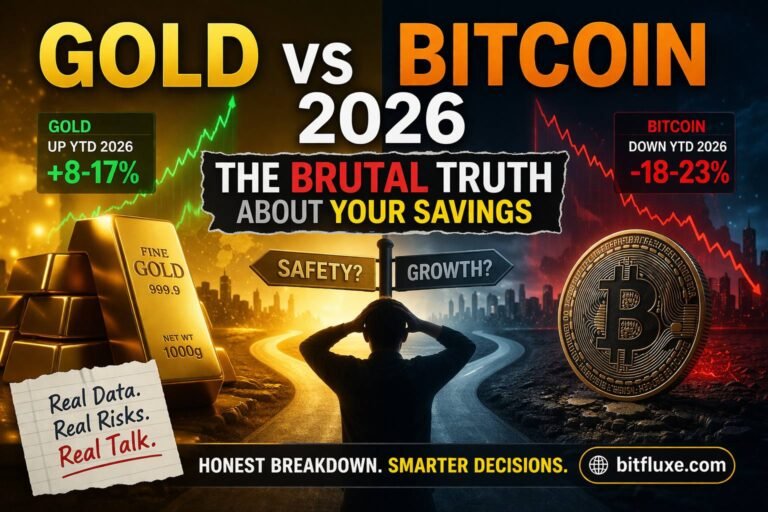
Tether Now Holds 116 Tonnes of Gold: What It Means for USDT, Bitcoin & Your Money in 2026
Nobody expected the world’s most controversial stablecoin company to quietly become one of the largest gold holders on the planet
Tether — the company behind USDT, the world’s most used stablecoin — now holds 116 tonnes of physical gold. That’s more than the gold reserves of countries like Hungary, Bangladesh, and dozens of other nations. And according to Bloomberg, they’re not done. Tether is on track to acquire another 100 tonnes before 2026 ends.
Why is a crypto company buying gold at central bank scale? What does it mean for USDT holders? And should this change how you think about stablecoins, Bitcoin, and your own money?
The Number That Should Shock You: 116 Tonnes of Gold
116 tonnes into perspective, because the number sounds abstract until you compare it.
Tether’s gold holdings are now larger than the entire gold reserves of these countries:
| Country | Gold Reserves |
|---|---|
| New Zealand | 0 tonnes |
| Ireland | ~6 tonnes |
| Bangladesh | ~14 tonnes |
| Hungary | ~94 tonnes |
| Tether (private company) | 116 tonnes |
| Portugal | ~382 tonnes |
| Germany | ~3,352 tonnes |
A private crypto company — one that many critics said was a house of cards just three years ago — now holds more gold than most sovereign nations.
Jefferies analysts reported this figure, which was subsequently cited by the Financial Times. CoinDesk confirmed that Tether’s gold purchases in the last quarter alone accounted for nearly 12% of total central bank gold buying globally.
Read that again. 12% of what all the world’s central banks bought combined.
This is not a small footnote. This is a structural shift in how the world’s largest stablecoin operator thinks about money.

Why Is Tether Buying Gold? The 3 Real Reasons
Tether doesn’t do anything by accident. Their $15 billion annual profit — yes, billion — gives them extraordinary purchasing power. Here’s why they’re deploying it into gold specifically.
Reason 1: Hedging Against Dollar Weakness
USDT is pegged to the US dollar. If the dollar weakens significantly, the purchasing power of Tether’s reserves shrinks. Gold, historically, moves inversely to the dollar. By holding gold, Tether is quietly hedging its own peg against dollar depreciation.
This is exactly what smart central banks do. And Tether is doing it at scale.
The DXY Dollar Index has weakened from 101 to around 99 in recent months. Gold has surged from $2,000 to over $4,700 per ounce in response. Tether’s gold position has gained billions in value since they started buying.
For a deeper look at how the dollar and gold interact, read our full analysis: DXY Dollar Index & Gold Price Correlation 2026.
Reason 2: Building Trust Through Real Assets
Tether has spent years fighting accusations that USDT isn’t fully backed. Critics claimed the reserves didn’t exist. Regulators demanded proof. Congressional hearings happened.
Gold answers all of that.
You can’t fake 116 tonnes of physical gold sitting in audited vaults. It’s tangible, verifiable, and universally trusted. By adding gold to its reserves, Tether is doing something clever: transforming a reputation liability into an asset.
Every tonne of gold Tether buys is a public statement: “We have real money backing your stablecoins.”
Reason 3: De-Dollarization Is Real — And Tether Sees It
Global de-dollarization — the slow movement away from USD as the world’s reserve currency — is a real trend. Central banks in China, Russia, India, and dozens of other countries have been diversifying into gold precisely because they want less dollar exposure.
Tether operates globally. A huge portion of USDT demand comes from countries with weak local currencies — Pakistan, Argentina, Nigeria, Turkey, Venezuela. In these markets, USDT isn’t just a trading tool. It’s a dollar substitute for people who can’t easily access real dollars.
If the dollar weakens significantly, USDT’s appeal weakens with it. Gold backing creates a hedge. Tether is essentially building a stablecoin that’s partially de-dollarized — even while being dollar-pegged. It’s a quiet strategic masterstroke.
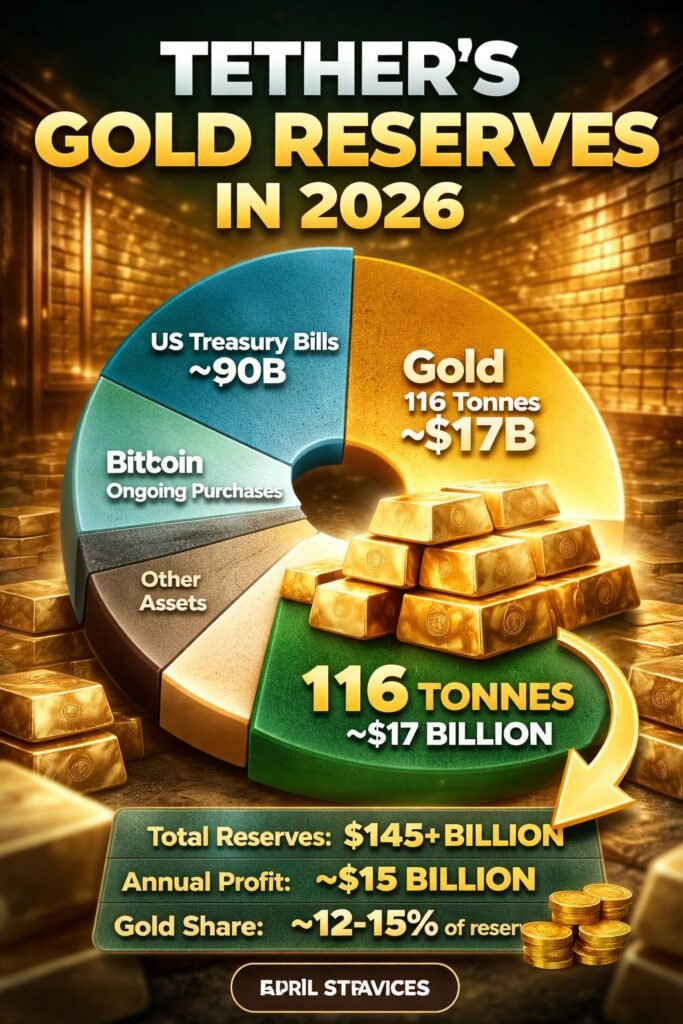
What Exactly Does Tether’s Reserve Look Like in 2026?
Featured Snippet Box — Tether Reserve Breakdown April 2026
Based on Tether’s latest transparency reports and analyst data:
- US Treasury Bills: ~$90+ billion (largest component)
- Physical Gold: 116 tonnes (~$17 billion at $4,700/oz)
- Bitcoin: Ongoing purchases from profits
- Other assets: Cash, money market funds, corporate bonds
- Total reserves: Exceeds total USDT in circulation
- Annual profit: ~$15 billion
- Gold as % of reserves: Approximately 12–15%
Does This Make USDT Safer Than Before?
Short answer: yes — but with important nuances.
How gold makes USDT stronger:
Gold adds a non-correlated asset to Tether’s reserves. During a US financial crisis or dollar collapse scenario, US Treasuries could theoretically lose value while gold surges. This means Tether’s reserves are now more resilient against extreme tail risks.
For the 400+ million people globally who use USDT as a dollar substitute, this is genuinely good news. The stablecoin they rely on has a stronger foundation.
The nuances you need to understand:
Gold itself is volatile. In January 2026, gold experienced one of its sharpest single-day drops in years before recovering. If Tether’s gold position drops 10% in value on a bad day, that represents roughly $1.7 billion in paper losses. That’s manageable at their scale — but it’s not the same as holding Treasury bills.
Also: Tether’s gold doesn’t directly back each individual USDT token. It’s part of a total reserve pool. USDT remains a dollar-pegged instrument. Gold is a diversifying buffer, not a gold standard.
Think of it this way: your USDT is still a dollar. But the company guaranteeing that dollar now has a gold vault as a backup. That’s meaningfully better than before.
USDT vs USDC in 2026: Does Gold Change the Safety Debate?
This is where it gets interesting.
For years, the conventional wisdom was: USDC is safer than USDT because USDC is regulated, transparent, and issued by Circle — a US-regulated company with clean audited reserves in US banks and Treasuries.
USDT had more liquidity and adoption, but USDC was considered the “institutional-grade” option.
Does Tether’s gold buying change this calculus?
What USDT now has that USDC doesn’t:
- Physical gold backing as a diversification layer
- Non-dollar asset exposure for crisis scenarios
- Proven reserve depth beyond dollar-denominated assets
What USDC still does better:
- Cleaner US regulatory compliance
- Fully audited by major accounting firms
- Simpler, more transparent reserve structure (cash + US Treasuries only)
- Better for institutional use cases requiring regulatory clarity
The honest verdict for 2026:
USDC remains the safer choice for institutional investors who need regulatory certainty. USDT — with gold backing — is now more interesting for global users who want dollar access plus some hedge against dollar-system risk.
They serve different purposes. The old “USDC is safer, full stop” narrative is becoming more nuanced.
For more on this debate, see our detailed breakdown: Is USDT Safe in 2026?
How Tether’s Gold Buying Affects Gold Prices Globally
Tether’s gold purchases — accounting for 12% of global central bank buying — represent a brand new, structural source of demand that didn’t exist before 2023. And it’s demand that isn’t going away.
Tether earns roughly $15 billion per year in profit (primarily from interest on its Treasury holdings). Management has explicitly stated they allocate a portion of profits to gold purchases ongoing. Bloomberg confirmed targets of another 100 tonnes in 2026.
This is persistent, recurring, non-price-sensitive demand.
Tether isn’t buying gold because it thinks the price will go up next week. They’re buying it for strategic reserve purposes — the same reason central banks buy. They don’t stop when prices rise. They don’t panic when prices dip.
That kind of buyer changes market dynamics. It creates a structural floor. Every major dip in gold now has a new category of buyer waiting: crypto stablecoin companies with billions in annual profits to deploy.
Check live gold prices and analysis tools at Bitfluxe Gold Rate USA.
What About XAUT — Tether’s Own Gold Token?
Many people don’t realize Tether already has a gold-backed crypto product: Tether Gold (XAUT).
XAUT is a separate token from USDT. Each XAUT token represents one troy ounce of physical gold stored in Swiss vaults. It trades on crypto exchanges and gives investors direct gold price exposure through blockchain.
XAUT is different from USDT’s gold reserves:
| USDT | XAUT | |
|---|---|---|
| What it is | Dollar stablecoin | Gold-backed token |
| Price stability | Pegged to $1 | Moves with gold price |
| Gold connection | Indirect (reserves) | Direct (1 token = 1 oz gold) |
| Use case | Payments, trading | Gold investment |
| Volatility | Very low | Follows gold |
The interesting development: as Tether buys more gold for its main reserves, it strengthens its credibility as a gold custodian — which indirectly supports XAUT’s reputation too.
For investors who want gold exposure via crypto, XAUT is worth understanding. For those who just want dollar stability with better backing, USDT’s gold reserve addition is the relevant news.
What This Means for Bitcoin
Will Tether’s gold buying hurt Bitcoin?
On the surface, you might think: if Tether is deploying profits into gold instead of Bitcoin, that’s less money flowing into BTC.
The reality is more nuanced.
Tether’s gold buying comes from its interest income on Treasury holdings — not from selling Bitcoin or reducing crypto exposure. It’s additive, not substitutive.
More importantly, a more reserve-stable Tether is bullish for the entire crypto ecosystem. If USDT ever faced a credibility crisis, it could trigger a liquidity crunch across all crypto markets — similar to what happened with UST/Luna in 2022, but at far larger scale. Stronger Tether reserves reduce that systemic risk.
Analysts broadly agree: a better-backed Tether means more confidence in crypto markets overall. That’s a net positive for Bitcoin.
Bitcoin currently trades around $70,000–73,000 in April 2026. If you want to calculate your Bitcoin returns or plan a DCA strategy, use our free tools: Bitcoin & Crypto Profit & DCA Calculators.
The De-Dollarization Angle: Why This Is Bigger Than It Looks
Most crypto news covered this story as “Tether buys gold.” The deeper story is about what it signals.
We are living through a slow, grinding shift in global monetary architecture. Central banks globally have been net buyers of gold for 15+ consecutive years. The share of US Treasuries in global reserves is declining. Countries are quietly reducing dollar dependence.
Tether — which sits at the intersection of the dollar system and the crypto economy — is making the same bet these central banks are making: gold holds value when fiat currencies don’t.
The irony is striking. Tether created a product (USDT) that lets people hold dollars digitally. Now Tether is hedging against the very dollar its product is pegged to. That’s not contradiction. That’s sophisticated treasury management.
For the 400 million+ USDT users globally — many of whom are in developing countries precisely because they don’t trust their local currencies — this is quietly reassuring. The dollar-pegged stablecoin they rely on is now backed by an asset that has preserved wealth for 5,000 years.
Featured Snippet Box — Key Numbers: Tether Gold 2026
- Gold held by Tether: 116 tonnes
- Estimated value: ~$17 billion (at ~$4,700/oz)
- % of global central bank gold buying: ~12% last quarter
- 2026 target: 216 tonnes (100 more to acquire)
- Tether annual profit fueling purchases: ~$15 billion
- USDT total market cap: ~$143 billion
- Gold as % of total reserves: ~12–15%
- Countries with less gold than Tether: Dozens
What Should You Do With This Information?
If you hold USDT:
Nothing changes for your day-to-day usage. USDT is still pegged to $1. But you can sleep slightly more soundly knowing the reserves behind your stablecoin are more diversified than before. No action needed.
If you’re comparing USDT vs USDC:
The gap has narrowed. USDC remains cleaner for institutional use. But USDT’s gold backing gives it a new argument in markets where dollar-system risk is a real concern. Consider your use case before switching.
If you’re a gold investor:
Note Tether as a new structural buyer. 12% of central bank equivalent buying is significant. This supports a higher floor for gold prices — not a reason to chase highs, but a reason to feel more confident in dip-buying strategies.
If you’re a Bitcoin investor:
A more stable Tether is broadly positive for crypto ecosystem health. This reduces systemic risk. No direct action needed — but it’s a bullish macro signal for the space overall.
If you’re in a developing country using USDT as a dollar substitute
This is the most directly relevant development for you. Your stablecoin of choice is becoming more resilient. Combined with the utility you already get from USDT (access to dollars without a US bank account), the gold backing is a quiet upgrade to an already useful tool.
For live PKR to USDT rates and conversion tools, visit: PKR to USDT Converter 2026.
FAQ
Q: How much gold does Tether hold in 2026?
As of April 2026, Tether holds approximately 116 tonnes of physical gold, according to analysis reported by Jefferies and cited by the Financial Times. This makes Tether one of the largest private gold holders in the world — exceeding the gold reserves of dozens of sovereign nations.
Q: Is USDT backed by gold?
Not directly. USDT is pegged to the US dollar, and its primary backing consists of US Treasury bills. Gold is a significant component of Tether’s broader reserve portfolio, representing approximately 12–15% of total reserves. Think of it as a diversifying buffer — your USDT is still a dollar, but with a gold safety net behind the company issuing it.
Q: Why is Tether buying gold instead of Bitcoin?
Tether buys both, but gold serves a specific strategic purpose: it hedges against dollar weakness and diversifies reserves away from dollar-denominated assets. Bitcoin is volatile — useful for growth, but not for reserve stability. Gold has a 5,000-year track record as a store of value and is universally accepted. For reserve management, gold is the more conservative and credible choice.
Q: Does Tether’s gold buying affect gold prices?
Yes, meaningfully. Tether’s purchases accounted for roughly 12% of global central bank equivalent gold buying in one recent quarter. This represents persistent, non-price-sensitive demand — Tether buys for strategic reasons, not to time markets. That kind of structural buyer supports a higher price floor for gold globally.
Q: Is USDT safer than USDC in 2026 because of gold?
The gold backing strengthens USDT’s reserves against extreme tail risks like dollar collapse scenarios. However, USDC maintains advantages in regulatory clarity and audit transparency. Neither is definitively “safer” — the right choice depends on your priorities. USDC for regulatory compliance; USDT for broader reserve diversification and global liquidity.
Q: What is XAUT — Tether’s gold token?
XAUT (Tether Gold) is a separate Tether product where each token represents one troy ounce of physical gold in Swiss vaults. Unlike USDT (dollar-pegged), XAUT moves with gold prices. It’s designed for investors who want gold exposure via blockchain, not for those seeking dollar stability. XAUT and USDT are different products serving different purposes.
Q: How does Tether afford to buy so much gold?
Tether earns approximately $15 billion annually in profit, primarily from interest income on its massive US Treasury holdings. With over $90 billion in Treasury bills earning 4–5% annually, the interest income alone exceeds the GDP of many small nations. Management allocates a portion of this profit to gold purchases as a strategic reserve decision.
This analysis is based on publicly reported data from Jefferies, the Financial Times, Bloomberg, and CoinDesk as of April 2026. Tether’s reserve composition is subject to change. USDT and other stablecoins carry risks including regulatory, counterparty, and market risks. Nothing in this article constitutes financial advice. Always conduct your own research before making financial decisions.
For live market data, real-time gold prices, and financial tools, visit Bitfluxe — your source for data-driven financial intelligence.

Hi, I’m Baber! I’m a blogger and crypto enthusiast dedicated to uncovering the best trading key levels in the financial markets. My mission is to break down advanced technical analysis tools into easy-to-follow guides for traders worldwide. When I’m not analyzing charts on TradingView, I’m busy researching the latest in blockchain security and SEO strategy to bring you the most accurate market updates.
View full details on our Terms and Conditions page.