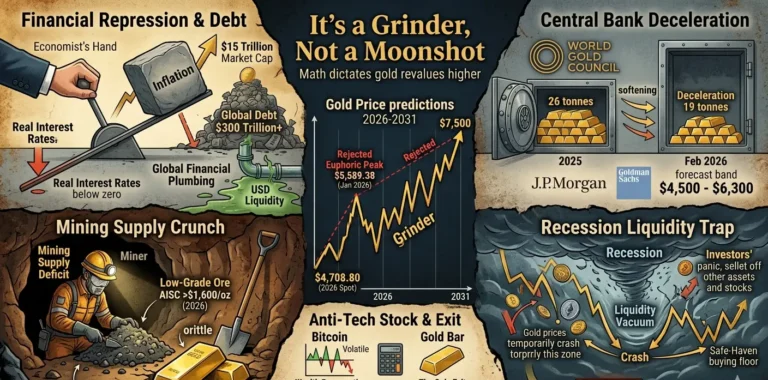
Gold vs Bitcoin in 2026-2030
Global central banks bought more than 1,000 tonnes of gold in 2024 and 2025 alone. That’s a level of accumulation we haven’t seen since the Nixon era. Most retail investors still think they’re forced to pick between “pet rock” gold and “magic internet money” Bitcoin. That binary choice is a relic. Gold vs Bitcoin in 2026-2030 isn’t about picking a winner. It’s about understanding that the traditional financial system is leaning on a broken crutch of debt. If you’re sitting on a pile of cash or 100% in a stock market that looks like a vertical line, you’re not “safe.” You’re just waiting for a structural shift you aren’t prepared for. Honestly, I’ve seen this before, where people wait for the “perfect time” to hedge, only to find the door has already slammed shut.
Right. Let’s get real about the numbers.
The US national debt is climbing by $1 trillion every 100 days. That’s not a typo. It’s a mathematical certainty that currency debasement is the only exit the Treasury has left. When you understand that, you stop looking at Bitcoin and gold as “investments” and start seeing them as the only things that aren’t tied to a sinking ship.

Is the Digital Gold debate finally over
The argument used to be that Bitcoin would eventually eat gold’s entire market cap. I’ll be blunt: that hasn’t happened. Instead, both assets surged in tandem as the global debt-to-GDP ratio crossed a terrifying 330% threshold. When the world drowns in liquidity, people don’t want one lifeboat. They want two.
Bitcoin has settled into its role as a high-velocity, sovereign-resistant asset. Gold remains the foundational layer of the global monetary system, whether Western bankers want to admit it or not. I’ve seen this pattern before in forex markets. When trust in the reserve currency wobbles, the oldest and the newest assets in the room are the first to get a seat at the table.
My read is that the “rivalry” was a marketing gimmick for social media influencers. The real players at firms like JPMorgan spent the last two years quietly building infrastructure to hold both. They aren’t choosing. They’re accumulating. You should probably take the hint.
Here’s the thing. Tracking the gold price in Pakistan against Bitcoin’s price swings during the same period tells a fascinating story about how both assets respond to dollar weakness simultaneously, not alternately.
Stop treating Bitcoin like a tech stock
For years, if the Nasdaq sneezed, Bitcoin caught a cold. But something changed when spot ETFs became the dominant market force. We started seeing days where tech stocks sold off hard on recession fears while Bitcoin held steady or actually ticked up. This surprised me. I expected the correlation to stay sticky much longer, but the data is starting to show a “flight to quality” that includes Satoshi’s invention.
But.
Bitcoin is still a volatile beast. You can’t put 90% of your life savings into it and expect to sleep when a 20% correction hits on a random Tuesday. It’s a tool, not a religion. Treat it like a tech stock, you’ll sell at the bottom. Treat it like a global liquidity barometer, you’ll stay the course.
Think about the psychology of the modern buyer. They aren’t buying Bitcoin because they think Nvidia is going to have a bad quarter. They’re buying it because they’ve lost faith in the government’s ability to manage a budget. That’s a completely different emotional driver than growth investing. It’s closer to catastrophe insurance.

Why Gold vs Bitcoin in 2026-2030 requires a Barbell Strategy
Why does a Barbell Strategy work for 2026-2030?** This approach pairs the stability of physical gold (low risk, low volatility) with the high growth potential of Bitcoin (high risk, high upside). A common starting point is a 70/30 split within the “alternative” portion of your portfolio, balancing capital preservation with aggressive upside.
The math for the standard 60/40 portfolio, meaning 60% stocks and 40% bonds, is fundamentally broken in a high-inflation environment. Bonds are supposed to be the safe part. They’ve been getting shredded instead. The Barbell Strategy replaces that dead weight with two very different hedges.
I could be wrong here, but I think a 50/50 split is too aggressive for most people. Gold should be the anchor. Bitcoin should be the engine. If the engine explodes, the anchor keeps the ship from drifting into the rocks. I’ve always preferred an asymmetric setup where I know exactly how much I can afford to lose while keeping my upside uncapped. Use the Bitcoin profit calculator to stress-test different allocation ratios against your actual numbers before committing.
Central banks don’t buy Bitcoin (yet), but they are inhaling gold
The World Bank noted that developing nations are leading the charge in gold accumulation. This isn’t a coincidence. Since the freezing of foreign reserves during recent geopolitical conflicts, every country on earth has realized that “money” sitting in a bank account is just a line of code a politician can delete.
Physical gold is the only financial asset that isn’t someone else’s liability. That’s a powerful realization. And I’ll be honest, the speed at which the East, specifically the BRICS nations, is moving away from dollar-denominated assets is faster than I anticipated. They’re building arbiter of value again.
That’s actually the problem for the average person. If you’re waiting for a gold standard to return before you buy, you’ll pay a massive premium. Smart money buys the insurance while the sun is still shining.
Now. Physical gold is the only asset that doesn’t need a password or a power grid to retain its value.
Harvest the chaos: The Volatility Arbitrage trick
Here’s where it gets interesting. Most people buy Bitcoin and just hold. That’s a fine strategy if you have nerves of steel, but it’s inefficient capital management.
The Rebalancing Trigger: Set a gold-to-BTC ratio for your portfolio. When Bitcoin goes on a parabolic run and exceeds its target weight by 20%, sell the excess and buy physical gold. You’re effectively locking in crypto gains into an asset that won’t drop 80% in a bear market.
This is what nobody tells you about wealth preservation. You use the high-risk asset to fund the low-risk asset. I’ve seen this before with tech founders who never sell their stock. They look like geniuses on the way up. They lose everything on the way down. Don’t be that person.
Is Bitcoin going to $1,000,000? Maybe. But wouldn’t you rather have 100 ounces of gold funded by Bitcoin gains along the way? The peace of mind is worth more than a few extra percentage points of theoretical profit. Check current PKR to USDT rates if you’re rebalancing across currencies, because the conversion timing can eat into your returns faster than you’d expect.
The 2030 Outlook: Will regulation kill the hybrid dream?
Right. We have to talk about the elephant in the room. The Fed and the IMF aren’t thrilled about people opting out of the system. We’re already seeing KYC rules tightening for both gold dealers and crypto exchanges.
There’s a real chance that by 2028, moving large amounts of Bitcoin into gold becomes a taxable nightmare or a regulatory obstacle course. My read is that governments will eventually try to corral these assets into institutional products like ETFs, where they can be easily tracked and taxed.
Wait. Does that mean you shouldn’t buy them? No. It means you need to be smart about how you hold them. Self-custody for Bitcoin and private storage for gold are becoming more than prepper talking points. They’re becoming tactical necessities.
Here’s what nobody tells you: the more governments regulate these assets, the more valuable the “outside” versions become. If buying physical gold in five years requires a thumbprint and a background check, what do you think the price will be?
Build your bunker now.
The window for cheap insurance is closing. As we head toward 2030, the global fiscal picture looks like a slow-motion train wreck. You can’t control the macro trends. You can control your exposure.
Will this hybrid strategy outperform a 100% Bitcoin portfolio in a massive bull run? No. Will it let you stay in the game if things go sideways? Yes. That’s the only goal that matters.
In my assessment, most people won’t do this. They’ll keep money in a savings account earning 0.5% while inflation chews through 7% of their purchasing power. They’ll complain about eggs and gas prices while refusing to buy the exact assets that protect against those price hikes. You can’t save everyone. You can only save yourself.
The next five years are going to be wild. Debt levels are too high, geopolitical tension is too thick, and the old rules of investing have been thrown out entirely. Gold and Bitcoin aren’t toys for speculators. They’re the foundation of a new way to think about money.
FAQ
Is Bitcoin replacing gold as a store of value in 2026?
The short answer: No. While Bitcoin is gaining ground with younger investors, it serves a different purpose. Gold remains the preferred reserve asset for central banks and institutions that require zero volatility and a 5,000-year track record.
What percentage of my portfolio should be in gold and Bitcoin?
It depends. If you’re 25 with a high income, you might lean 70% Bitcoin and 30% gold within your hedge bucket. If you’re 50 and approaching retirement, you’d likely flip that to 80% gold and 20% Bitcoin to protect what you’ve already built.
How do CBDCs affect Bitcoin and gold?
CBDCs are essentially a massive advertisement for the anti-fiat duo. As governments tighten control over how you spend digital dollars, demand for “outside” money, meaning gold and Bitcoin, will likely accelerate sharply.
Is Bitcoin more correlated to stocks or gold right now?
Historically it tracked the Nasdaq, but we’re watching that shift in real time. As of 2026, Bitcoin is increasingly trading like a liquidity asset, moving more in line with global M2 money supply than individual tech earnings.
Will gold hit $3,000 before Bitcoin hits $150,000?
My take: gold is much closer to fair value based on inflation than Bitcoin is to its full adoption price. I’d bet on gold hitting its milestone first. The macro tailwinds for sovereign buying are relentless right now.
What if the internet goes down? Can I still use my Bitcoin?
This is the ultimate skeptic’s question. If the entire global internet goes down permanently, you have bigger problems than your portfolio. You’ll be trading gold coins for canned goods and ammunition. For short-term outages, mesh networks and satellite links keep the ledger alive.
Are you going to keep watching the 60/40 ship sink, or are you going to start building your barbell? The data is screaming at you. Don’t wait until the rest of the world catches on.
About This Analysis: The data and forecasts referenced here come from publicly available reports by the World Gold Council, BlackRock, the IMF, the Fed, and JPMorgan. The editorial perspective represents the Bitfluxe team’s interpretation of current market conditions based on ongoing coverage of gold, crypto, and forex markets since 2024. This is not financial advice.

Hi, I’m Baber — founder of Bitfluxe and a crypto and forex enthusiast with a passion for financial markets. I specialize in breaking down technical analysis concepts like support/resistance levels, RSI, and MACD into simple, actionable guides for everyday traders. I spend most of my time analyzing charts on TradingView, tracking gold (XAU/USD) price movements, and researching blockchain security trends. My goal at Bitfluxe is simple: to give retail traders access to the same clear, data-driven insights that professional traders use — without the jargon.