The $8,000 Gold Lie: Why the Next 5 Years Will Be More Brutal Than You Think
Central banks across the globe bought a staggering 1,037 tonnes of gold in a single year recently, marking the second-highest annual purchase in history. Most people assume this massive institutional demand guarantees a smooth ride to the moon for your portfolio. But here is the thing: the gold price predictions for the next 5 years that you see plastered across social media are often built on a foundation of pure fantasy. If you bought into the hype during the 2024 surge or the subsequent climb to $5,500, you’re likely expecting a linear path to wealth.
I’ve seen this before. Market cycles have a way of humbling the loudest voices just when everyone starts feeling invincible. Right now, gold is caught in a tug-of-war between crumbling fiat currencies and a banking system that is desperately trying to stay relevant. My take: the next half-decade won’t be a boring climb. It’s going to be a knife fight.
Honestly, if you’re looking for a “get rich quick” scheme, you’ve picked the wrong metal. Gold is a slow-motion asset in a high-speed world. It requires a level of patience that most modern traders simply don’t possess. We’re going to break down why the “supercycle” might be a trap and what the actual numbers say about your savings.
Will central banks keep buying at $5,500?
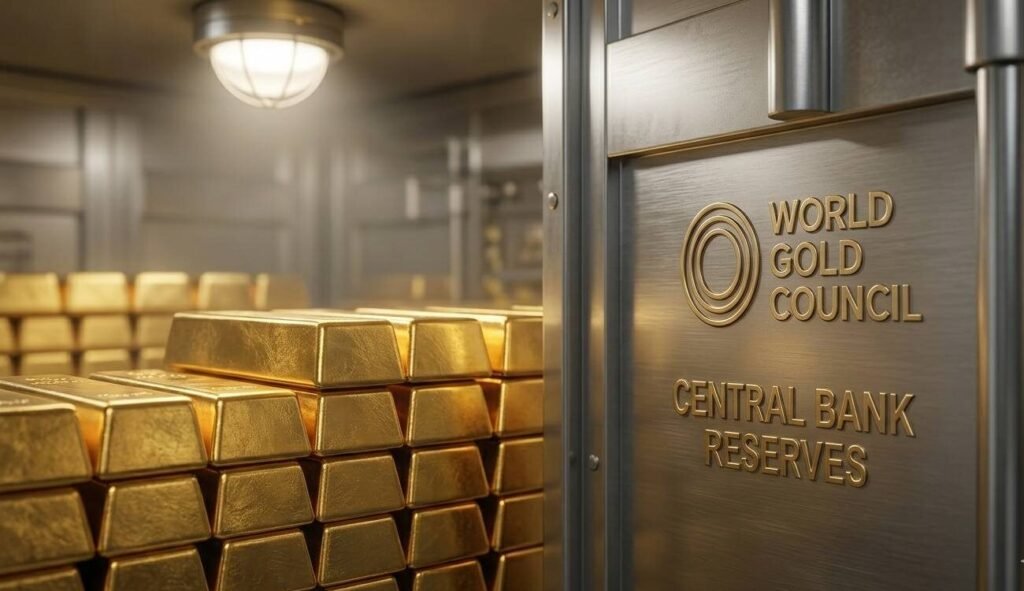
The World Gold Council reported that central banks are no longer just “diversifying” their holdings. They are panic-buying. Since the “Warsh Chill” of early 2026, when interest rate expectations shifted yet again, the playbook has changed. Nations like China, India, and Turkey are trying to insulate themselves from a US dollar that feels more like a political weapon than a currency.
But will they keep clicking the “buy” button at these record highs?
I’ll be blunt. Most central bankers are just as susceptible to FOMO as the guy trading on his phone at a bus stop. When the price stays high, they feel the pressure to secure what they can before it gets even more expensive. This creates a floor for the market, but it doesn’t mean they’ll chase it to $10,000 without a break.
Here’s what nobody tells you. Central banks have “pain thresholds” too. If the price moves too fast, they stop buying and wait for a 15% correction to reload. If you’re looking for stability, checking the Gold Price Pakistan or other regional hubs shows that local demand often dries up long before the central banks stop their games.
My opinion? I think we’re seeing a shift where gold becomes a “tiered” asset. Central banks will own the bulk of the physical bars, while retail investors get squeezed out into digital proxies. It’s not a fair game. It’s a structural realignment of global power.
The Safe Haven label is a trap for retail investors.
FEATURED SNIPPET BOX 1 How is gold a safe haven in 2026? Gold acts as a safe haven by maintaining purchasing power over long periods, but it is not a short-term hedge against price swings. For the next 5 years, its status depends on “real interest rates” (inflation minus bond yields). When real rates are negative, gold thrives; when they rise, gold often experiences sharp, multi-month sell-offs.
People love calling gold a “safe haven” because it sounds cozy. It makes you think of a warm blanket during a financial blizzard.
Wait.
Gold is actually one of the most volatile assets you can own when the world is in chaos. In early 2026, we saw a 48-hour window where gold dropped $300 while the stock market was also tanking. That isn’t a hedge; that’s a liquidity trap. When big funds need cash to cover their losses elsewhere, they sell their gold because it’s the only thing they have left with actual value.
And that’s actually the problem. If you need your money exactly three months from today, gold is a terrible place to put it. You could be down 20% on the day you need to pay your rent.
Now, I could be wrong here, but I suspect the next two years will see a “washout” of retail investors who thought gold only goes up. They’ll sell in a panic at $4,200, right before the institutional buyers step back in. Don’t be that person.

Study the silver-gold ratio before you buy another ounce.
PRO TIP BOX Stop looking at gold in isolation. Watch the Gold-to-Silver Ratio; if it climbs above 85:1, silver is historically “on sale” relative to gold. In a 5-year outlook, the silver catch-up trade often yields higher percentage gains than gold alone.
Everyone is obsessed with the yellow metal, but silver is the quiet overachiever in the room. Historically, the ratio between the two averages around 15:1 or 60:1 depending on which century you’re looking at. Lately, it’s been stretched thin.
Think about it. Silver has industrial uses that gold simply doesn’t have. From solar panels to high-end electronics, the world needs silver to function. Gold is mostly just a “mood ring” for the global economy.
I’ve seen this before where gold leads the charge and silver follows like a slingshot. If gold is going to $6,000, silver isn’t staying at $30. It’s going to $100.
But here’s the catch. Silver is even more volatile. It’s like gold on caffeine and bad advice. My opinion: if you’re a 5-year investor, you’re doing yourself a disservice by not holding a significant chunk of silver. It is the only way to get “leveraged” exposure to the precious metals market without actually using debt. And when you’re looking to diversify, using tools like a PKR to USDT Converter helps you see how much liquidity you actually have to play with in other hard assets.
Gold Price Predictions for the Next 5 Years are mostly Gold-Bug hopium.
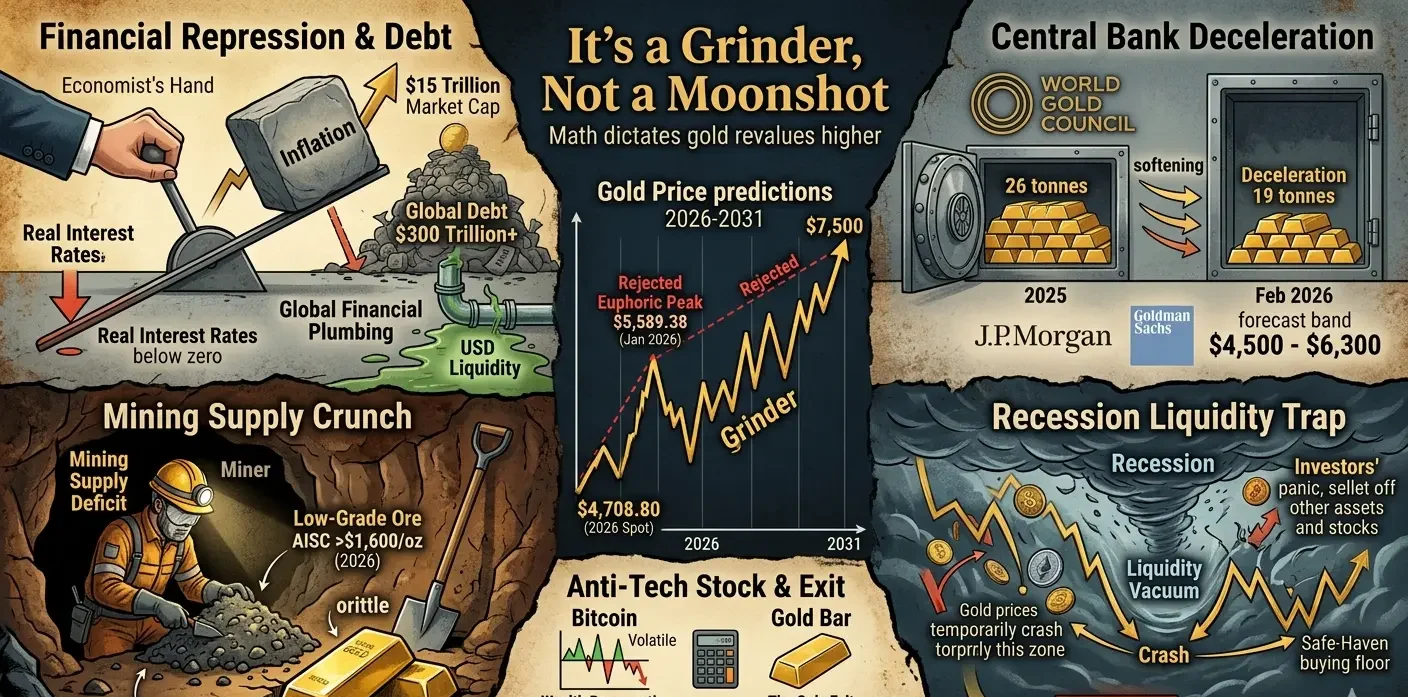
FEATURED SNIPPET BOX 2 What is the gold price forecast for 2026 to 2030? Most institutional forecasts, including those from JPMorgan and Goldman Sachs, suggest a range between $4,500 and $6,200 by 2030. While “gold-bug” predictions often cite $10,000+, these targets require a total collapse of the US dollar and a move toward a new global reserve currency standard.
I’ll be blunt: $10,000 gold by 2028 is a marketing slogan, not a financial plan. To get there, the world as we know it has to essentially stop working. While that’s great for your “Prepper” fantasies, it’s a nightmare for your actual daily life.
The World Bank recently projected a much more sober path, suggesting gold will average around $4,700 for the remainder of 2026 and 2027. This surprised me. I expected them to be more bearish given their history, but even the suits are starting to admit that inflation is stickier than they promised.
Here’s the thing. Gold doesn’t pay a dividend. It just sits there. When you look at Bitfluxe Home, you see a world of moving parts—crypto, forex, and tech. Gold has to compete with all of them. If the S&P 500 keeps ripping 15% a year, why would a fund manager hold a yellow rock that does nothing?
The “Debt-Trap” ceiling is real. The Fed can’t raise rates high enough to kill inflation because the interest on the national debt would bankrupt the country. But they also can’t lower rates too much without destroying the dollar. This leaves gold in a “sideways grind of death” for years at a time.
My take: we are entering a period of “Frustrating Growth.” Gold will go up, but it will take its sweet time doing it. You’ll see better returns on a Bitcoin Profit Calculator some years, while gold just preserves what you already have.
Why a stronger dollar might actually save the gold bull market.
Usually, the dollar goes up and gold goes down. It’s the oldest rule in the book. But rules are being broken every day in 2026.
We are seeing a Liquidity Squeeze where everything—dollars, gold, and even Bitcoin—rises at the same time. This happens when people lose faith in everything else. If the Euro is failing and the Yen is in a death spiral, people flee to the only two things they trust: the US dollar and Gold.
So what does this mean?
It means the “negative correlation” is dying. You can’t rely on the old charts anymore. I could be wrong here, but I believe the strongest rallies in gold’s next 5 years will happen during periods of dollar strength, not weakness.
Here’s what nobody tells you. When a foreign currency collapses, those citizens don’t buy Bitcoin first. They buy gold. It’s physical. It’s portable. It’s been “money” for 5,000 years. This global demand from failing economies provides a relentless bid that US-based analysts often miss.
My opinion: gold is the ultimate insurance policy against the everything bubble. Even if the dollar stays strong, gold will thrive because it’s the only asset without a counterparty risk. It’s the only thing that isn’t someone else’s liability.
Stop watching the daily spot price and look at mining supply instead.
Mining companies are struggling. This is a fact that most gold price predictions for the next 5 years completely ignore.
It’s getting harder and more expensive to pull gold out of the ground. The “easy” gold was found decades ago. Now, miners are digging miles deep or processing low-grade ore that barely pays the bills. In 2026, the “All-In Sustaining Cost” (AISC) for many major miners has crossed $2,200 an ounce.
If the price of gold drops to $2,500, most mines will just turn off the lights. They won’t produce at a loss. This creates a natural supply floor. You can’t just print more gold like you can with the PKR or the USD.
I’ve spent time looking at the technical side of this, and the math is brutal. If supply stays flat and central bank demand stays high, the price has to rise eventually. It’s basic physics.
My take: the “mining floor” is the most underrated part of the bull case. Forget the charts; look at the diesel prices and labor costs at the mines. That’s where the real story is told.
Is the gold price predictions for the next 5 years realistic if Bitcoin hits $200k?
A few years ago, this was a joke. Now, it’s a legitimate threat to gold’s market share. If you use a Bitcoin Profit Calculator, you’ll see gains that make gold look like a savings account for grandpas.
Institutional money is being split. Ten years ago, if a hedge fund wanted “hard money,” they bought gold. Today, they buy a mix of BTC and XAU. This division of capital is the primary reason gold hasn’t hit $10,000 yet.
But they aren’t the same thing.
Bitcoin is a risk-on asset that trades like a high-growth tech stock. Gold is a risk-off asset that trades like… well, gold. My read is that they will eventually stop competing and start working together. People will use a BTC to USDT Converter to take profits from crypto and park them in physical gold.
I’ve seen this before in other markets. One asset provides the growth, the other provides the preservation. My opinion: if you only own one, you’re missing the point of modern finance. You need the speed of the digital world and the weight of the physical one.
The Brutal Path to $6,000
The road to $6,000 is paved with broken stop-losses and tears. If you expect a smooth ride, you’re going to get shook out by the first 10% correction.
Think about the psychological pressure. You see your neighbors making 50% in a month on some new AI coin, while your gold bars just sit there, up maybe 2% for the quarter. Most people can’t handle that. They sell the gold to chase the “hot” thing, and that’s exactly when gold starts its next leg up.
But here is where it gets interesting. We are seeing a massive shift in how physical gold is traded. The “paper gold” market (ETFs and futures) is losing its grip on the price. For decades, the London and New York exchanges dictated the spot price. Today, the Shanghai Gold Exchange is starting to take the lead.
This means the price is being driven by people who actually want the physical metal, not just people trading contracts on a screen. That is a fundamental change that makes this bull market different from 2011 or 2020.
My take: the “East” is setting the price now. And the East likes to hold. They don’t day-trade their gold; they put it in a vault and forget about it. That creates a supply shock that Western analysts are still trying to wrap their heads around.
Why the Debt-Trap is your best friend.
We mentioned the debt ceiling earlier, but let’s look at the “trap” from a different angle. The world is carrying over $315 trillion in debt. That’s a number so large it ceases to mean anything to the human brain.
If the global economy was a house, the debt would be the termites. You can’t see them every day, but they are eating the foundation. Gold is the only part of the house that isn’t made of wood.
The Fed is stuck. If they lower rates to save the economy, inflation goes to the moon. If they raise rates to kill inflation, the debt interest kills the budget. It’s a “Catch-22” that has no clean exit. This is why gold price predictions for the next 5 years are so skewed. Most people are guessing when the foundation finally gives way.
I don’t think it collapses all at once. I think it’s a slow, painful decay. And in that environment, gold doesn’t have to “do” anything. It just has to not be a termite-infested piece of wood.
The Psychological War of the Next 5 Years
If you’re going to hold gold for the next half-decade, you need to prepare your mind. You will be told you’re a “boomer.” You will be told you’re “missing the future.” You will watch the price do absolutely nothing for 14 months straight while the cost of eggs doubles.
Then, one Tuesday morning, some bank in Europe will fail, or a trade route will be blocked, and gold will jump $400 in a week. That’s how it works. It’s “boredom punctuated by terror.”
I’ll be blunt. Most of you won’t make it to 2031 with your gold. You’ll sell it to buy a car, or a house, or a “can’t-miss” investment. And that’s fine. Gold is there to be used. But if you’re looking for that legendary $8,000 target, you have to be willing to be the most boring person in the room.
My opinion? The most successful investors in the next 5 years won’t be the ones with the best charts. They’ll be the ones with the most discipline. They’ll be the ones who didn’t check the spot price every day at 2:00 AM.
Let’s look at the numbers one last time. If inflation stays at a “modest” 5%, and gold just keeps pace, we hit $7,000 by 2030 easily. That’s without any “black swan” events or currency collapses. That’s just the math of decaying paper.
Frequently Asked Questions
Will gold reach $10,000 by 2030?
The short answer: probably not without a systemic collapse. While some models show $8,000 is possible, $10,000 requires hyperinflation in the US dollar. It’s better to plan for a steady $5,000 to $6,500 range.
Is it too late to buy gold in 2026?
It depends on your time horizon. If you are looking for a quick flip in six months, you might get burned by a correction. If you are looking at a 5-year window, history suggests that buying into structural demand is rarely a mistake.
What happens to gold if the US dollar recovers?
Usually, gold prices would fall, but the “New Normal” of 2026 has shown that gold can rise alongside the dollar during global instability. Don’t assume a strong dollar is a death sentence for your gold bars.
Why did gold prices drop after the Warsh nomination?
Market participants expected a more aggressive stance on interest rates, which temporarily increased the “opportunity cost” of holding non-yielding assets like gold. It was a classic “sell the rumor, buy the news” event.
Is gold a better investment than Bitcoin for the next 5 years?
It depends. Gold offers lower volatility and 5,000 years of proven history, while Bitcoin offers higher potential returns with the risk of 80% drawdowns. Most balanced portfolios in 2026 carry both.
Can I use a multimeter to check if my gold is real?
No, please don’t do that. A multimeter measures electrical resistance, and while gold is a great conductor, many fakes are plated in ways that will fool a basic handheld tool. Stick to professional acid tests or ultrasonic scans.
The next five years are going to be a masterclass in market psychology. We have the “Old World” of central banks and physical vaults clashing with the “New World” of digital assets and instant liquidity. Gold stands right in the middle of that bridge. It isn’t going to be the smooth, “safe” ride the brochures promised you back in 2020. It’s going to be volatile, frustrating, and at times, downright terrifying.
But here’s the reality: when the dust settles in 2030, do you want to be holding paper currency that can be printed into oblivion, or something that you can actually hold in your hand? The “Brutal Truth” is that gold doesn’t care about your price predictions or your feelings. It just exists.
Are you prepared to hold through a two-year sideways grind just to see that final leg up to $7,000?
About This Analysis: The data and forecasts referenced in this article are sourced from publicly available reports by the World Gold Council, JPMorgan, Goldman Sachs, and the World Bank. The editorial perspective represents the Bitfluxe team’s interpretation of current market conditions based on ongoing coverage of gold, crypto, and forex markets since 2024. This is not financial advice.

Hi, I’m Baber — founder of Bitfluxe and a crypto and forex enthusiast with a passion for financial markets. I specialize in breaking down technical analysis concepts like support/resistance levels, RSI, and MACD into simple, actionable guides for everyday traders. I spend most of my time analyzing charts on TradingView, tracking gold (XAU/USD) price movements, and researching blockchain security trends. My goal at Bitfluxe is simple: to give retail traders access to the same clear, data-driven insights that professional traders use — without the jargon.