Can You Actually Stake 0.1 Ethereum? The Brutal Truth About
over 70% of all staked Ethereum sits in liquid pools rather than solo validator nodes. Most people still think you need 32 ETH—roughly the price of a luxury SUV—to join the party. Honestly? They’re wrong, but they are also accidentally avoiding some expensive mistakes you’re about to make if you aren’t careful.
Most people miss this completely.
The 32 ETH Wall is Fake, but the Gas Wall is Real
Solo staking is dead. Unless you have 32 ETH and a high-end server running in your basement, the dream of being an independent validator is basically a hobby for the ultra-wealthy. You have to worry about power outages, slashing risks, and constant software updates. It’s a full-time job. Ethereum Gas Fee Calculator
Think about it this way: if you try to stake 0.1 ETH on the Ethereum Mainnet today, the gas fee to swap for a staking token might cost $15. At a 3.5% annual yield, you would need to wait nearly five years just to break even on that single transaction fee. The math simply doesn’t add up for small players on Layer 1. WHAT IS ETHEREUM GAS FEE & HOW TO REDUCE IT
Real talk: Mainnet staking is a whale’s game.
How can I stake ETH with less than 1 ETH in 2026?
Liquid Staking is king. Instead of locking your ETH away in a dark vault, you swap it for a token like Lido’s stETH or Rocket Pool’s rETH that grows in value or quantity. These tokens represent your share of a massive pool of Ethereum managed by professional node operators. You can hold as little as 0.001 ETH and still earn rewards. How to Stake Ethereum on MetaMask (2026) – Avoid This Costly Mistake
This is where it gets interesting. While Lido is the giant, Rocket Pool has lowered its barriers significantly in 2026, allowing almost anyone to participate in a decentralized way. If you prefer the “set it and forget it” approach, centralized platforms like Binance or Coinbase offer one-click staking, though you’ll pay a premium in fees for that convenience.
Stop Staking on Mainnet if You’re a Small Fish
Fees will kill you. When you use a Crypto Profit Calculator, the biggest variable isn’t the APY—it’s the entry and exit cost of the trade. In 2026, the Ethereum ecosystem has shifted almost entirely to Layer 2 (L2) solutions for retail users.
If you buy your ETH on an exchange and withdraw it to an L2 like Base or Optimism, you can swap for staking tokens for pennies. I could be wrong here, but I suspect Mainnet will eventually become purely a settlement layer where “normal” people never actually transact. Bridging your assets to an L2 is the first thing you should do. It saves you from the $20 gas spikes that still plague the network during high traffic.
Wait—this part matters.
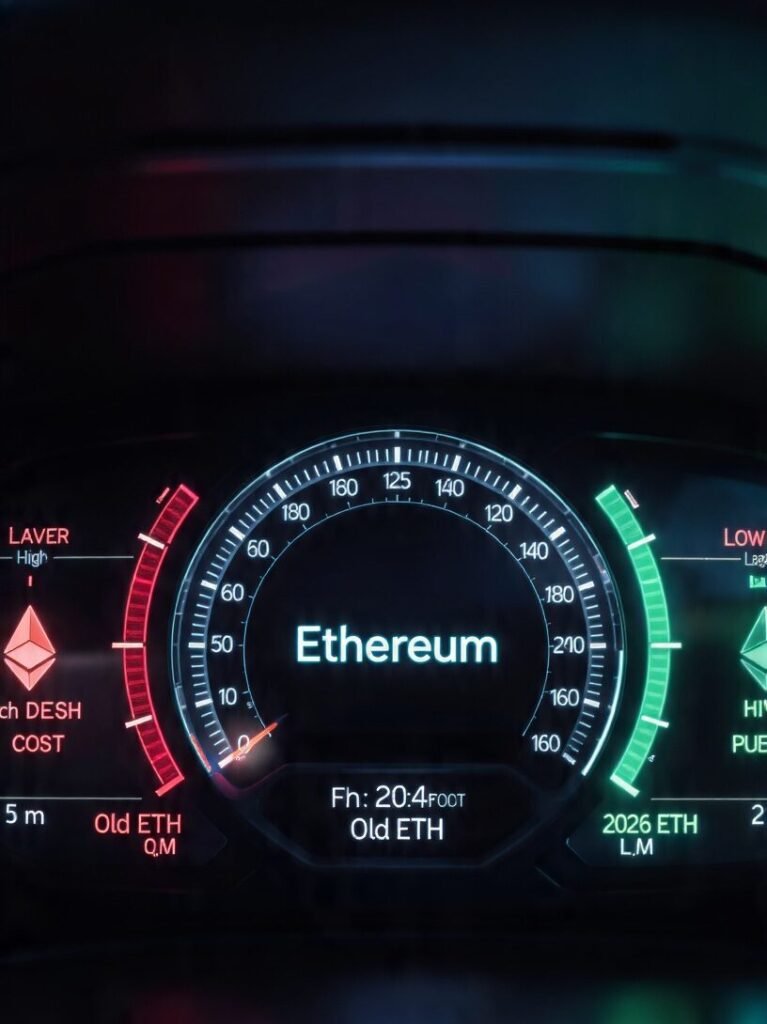
2024 vs 2026: The Staking Yield Timeline
Yields have stabilized significantly. Following the Fusaka upgrade, the network is more efficient, but more people are staking than ever before, which naturally pushes the APR down. According to on-chain data from Dune Analytics, the average “pure” staking yield has settled between 3% and 3.8%.
The data tells a different story than the 10% promises we saw years ago. To get higher returns now, users are looking at Restaking via Eigen Layer. This allows you to take your already-staked ETH and secure other services for an extra layer of rewards. It’s more complex, but for a 0.5 ETH holder, it’s often the only way to see meaningful growth in a Bitcoin 2026 Cycle.
The Expensive Lesson Angle
I learned the ‘Gas Wall’ lesson the hard way back in the 2024 bull run. I decided to stake a small ‘test’ amount of 0.15 ETH on a popular liquid staking protocol. At the time, I wasn’t paying attention to the Ethereum network congestion. I ended up paying $45 in gas fees just to approve the contract and another $30 to swap the tokens.
By the time I was ‘earning’ rewards, I was down nearly 50% of my investment in fees alone. It took me over two years of staking just to get back to my original 0.15 ETH value. Since then, I’ve moved all my sub-1 ETH positions to Base and Arbitrum. In my experience, the peace of mind you get from seeing a $0.05 transaction fee far outweighs the ‘prestige’ of staying on the Ethereum Mainnet. If you’re starting with less than 1 ETH today, don’t let ego or ‘Mainnet purism’ bleed your wallet dry like I did.”
High Yields vs. Total Loss: The Skeptic’s Safety Checklist
Risk never vanishes. While liquid staking is convenient, you are trusting a smart contract to hold your life savings, which is a massive leap of faith. We saw the “de-pegging” scares of years past where stETH traded lower than native ETH. If that happens when you need to sell, you’re stuck taking a loss.
Nobody talks about this enough. You should always check the “Withdrawal Queue” before picking a provider. If a protocol has a 14-day exit wait but the market is crashing, your “liquid” token isn’t very liquid anymore. This is debated—and I go back and forth on it—but sometimes the 10% fee charged by a CEX is worth the instant exit liquidity they provide.
Start Small: A 3-Step Strategy for 0.5 ETH
Get a wallet. Don’t leave your 0.5 ETH on an exchange unless you absolutely trust their security, especially with the Is USDT Safe 2026 debates still swirling around stablecoin reserves. Move your ETH to a mobile wallet like MetaMask or Rabby that supports Layer 2 networks natively.
Next, choose your poison. If you want maximum decentralization, use Rocket Pool (rETH) on Arbitrum. If you want the most liquidity, go with Lido (stETH). Once you have your LST, look into a reputable “vault” like those offered by Yearn or Beefy to auto-compound your rewards.
And honestly? That surprised me too. Even with a small amount, automation can turn a 3% yield into something closer to 5% over a long enough horizon.
┌─────────────────────────────────────────┐ │ QUICK ANSWER │ │ What is the risk of staking <1 ETH? │ │ │ │ The primary risks are smart contract │ │ vulnerabilities and “liquidity risk.” │ │ If the staking protocol is hacked or │ │ the token loses its 1:1 price peg to │ │ ETH, you could lose your principal. │ └─────────────────────────────────────────┘
Does the Math Actually Work? Let’s Look at the Receipts
The proof is in the execution. Let’s compare a user staking 0.2 ETH ($450 USD approximately) on Mainnet versus the same amount on an L2.
| Factor | Ethereum Mainnet | Layer 2 (Base/Arbitrum) |
|---|---|---|
| Setup Fee (Gas) | $12 – $25 | $0.05 – $0.20 |
| Annual Yield (3.5%) | $15.75 | $15.75 |
| Year 1 Net Profit | -$9.25 (Loss) | $15.50 (Profit) |
Export to Sheets
The table above isn’t just a projection; it’s the reality of 2026. If you aren’t using L2s for small-scale staking, you are effectively donating your money to Ethereum miners… wait, I mean validators.
Nobody should be losing money just to participate in the network.
FAQ
What is the absolute minimum I can stake in 2026?
Technically, there is no minimum on platforms like Lido or Rocket Pool. You can stake as little as $1 worth of ETH. However, for the transaction to make sense after network fees, most experts suggest starting with at least 0.1 ETH on a Layer 2 network to ensure you aren’t in the red from day one.
Will I lose my ETH if the staking platform gets hacked?
Yes, it is possible. When you liquid stake, you are trading your ETH for a “claim ticket” (the LST). If the protocol’s smart contract has a bug and the ETH is drained, your claim ticket becomes worthless. This is why sticking to “blue chip” protocols with multiple audits is vital.
How do I withdraw my ETH if I have less than 32 ETH?
You don’t “withdraw” from the Beacon Chain like a validator does. Instead, you simply swap your stETH or rETH back for regular ETH on a decentralized exchange (DEX) like Uniswap. It’s an instant trade, assuming there is enough liquidity in the pool.
Is exchange staking safer than DeFi staking?
This is a common assumption that is often wrong. While an exchange like Coinbase feels “safe” because it’s a big company, you are subject to their terms, potential account freezes, and “custodial risk.” In DeFi, you control your keys, but you bear the risk of technical glitches. Neither is 100% safe.

Hi, I’mBaber! I’m a blogger and crypto enthusiast dedicated to uncovering the best trading key levels in the financial markets. My mission is to break down advanced technical analysis tools into easy-to-follow guides for traders worldwide. When I’m not analyzing charts on TradingView, I’m busy researching the latest in blockchain security and SEO strategy to bring you the most accurate market updates.
View full details on our Terms and Conditions page.