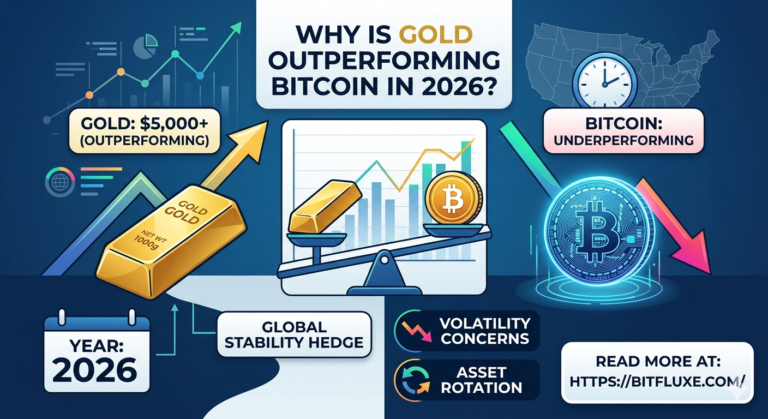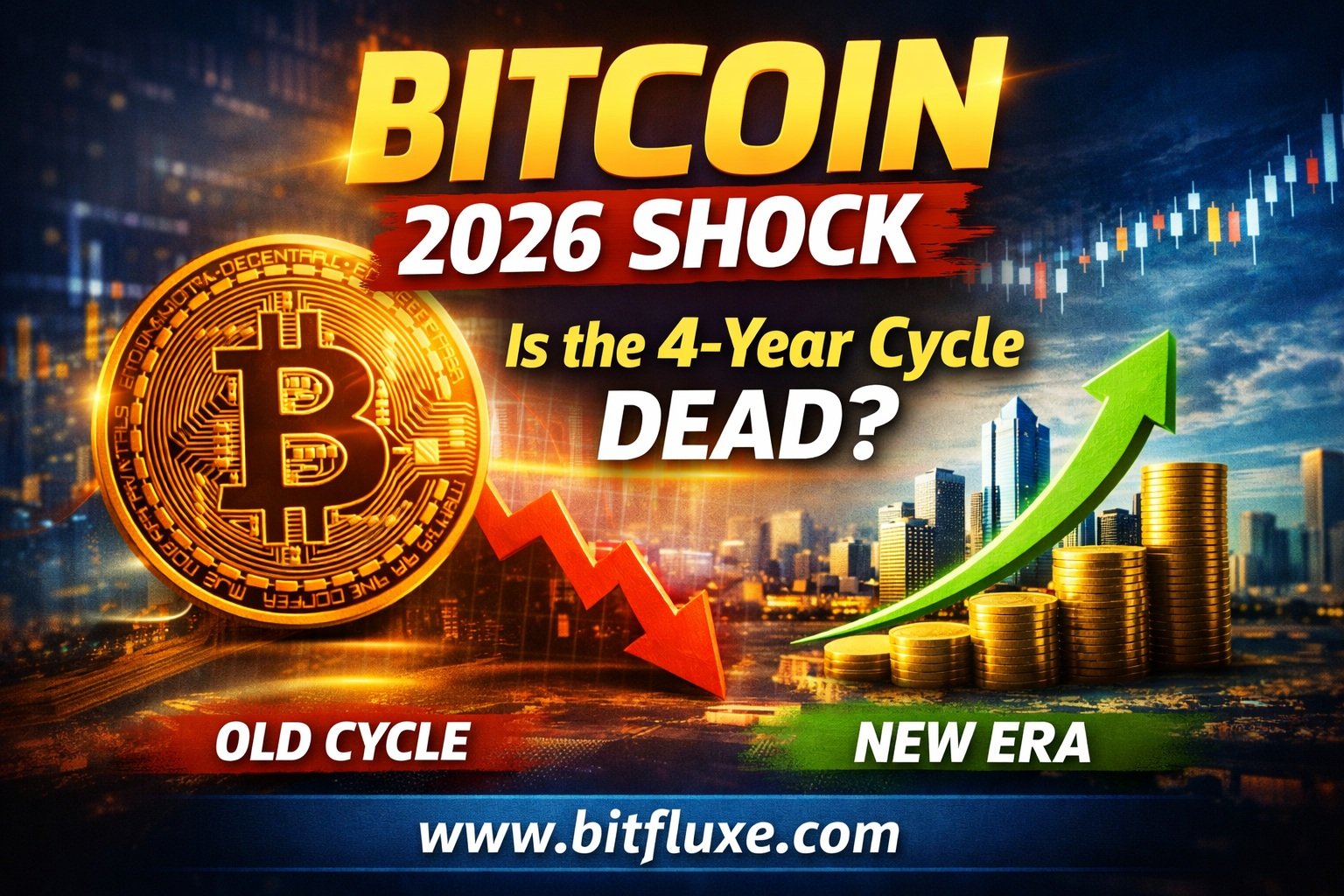
Bitcoin in 2026: Why the 4-Year Cycle is Changing
A $100 Billion Question
Imagine waking up in 2014, 2018, or even 2022. If you saw a Bitcoin price correction, your heart would sink because you knew an 80% crash was likely coming. That was the “Retail Era”—a time when high-leverage traders and emotional investors ruled the charts. But here’s the kicker: as we move through 2026, that old fear is being replaced by something we’ve never seen before—stability.
Did you know that in the first quarter of 2026 alone, institutional inflows into Spot ETFs surpassed the total retail buying power of the entire 2017 bull run? The script hasn’t just been edited; it’s been completely rewritten. If you’re still waiting for a “traditional” crypto winter to buy the dip, you might be staring at a bottom that no longer exists. next part Is 20 Millionth Bitcoin is Mined? Actually Worth It?
The Core Insight: The Institutional Era is Here
In my experience building financial tools at Bitfluxe, I’ve seen thousands of users track the “Halving” as the only holy grail. But here’s the thing: The Halving is no longer the primary driver of Bitcoin’s price. We have entered the Institutional Era. In the past, Bitcoin moved because of a supply shock (the Halving). Today, it moves because of a demand shock. When trillion-dollar asset managers like BlackRock and Fidelity integrate Bitcoin into their core portfolios, the “4-year cycle” (based on 4 years of supply changes) starts to blend into the much larger “Global Liquidity Cycle.”
Bitcoin is no longer a “tech experiment” for hobbyists; it is now a Macro Asset. It reacts to Federal Reserve interest rates, global inflation, and M2 money supply more than it reacts to a block reward being cut in half.
Myth vs. Reality: Debunking the 4-Year Cycle
| Myth | The Fact-Based Reality |
| Myth: Bitcoin must crash 80% after every peak. | Reality: Institutional “buy-walls” and corporate treasuries create a floor, making 20-30% corrections the new “crash.” |
| Myth: Only the Halving causes a bull market. | Reality: Global liquidity and ETF inflows now contribute 3x more buying pressure than the Halving supply cut. |
| Myth: Bitcoin is too volatile for “safe” investing. | Reality: In 2026, Bitcoin’s 180-day volatility has dropped to levels comparable to high-growth tech stocks (like Nvidia). |
| Myth: Miners control the market price. | Reality: Institutional custodians now hold more BTC than all major mining pools combined. |
Case Study: The $12 Billion Bhutan & MicroStrategy Effect
Let’s look at the data. In late 2025 and early 2026, we saw two massive real-world examples of why the cycle has changed:
- Sovereign Adoption (The Bhutan Move): When Bhutan moved a portion of its Bitcoin holdings, the market didn’t collapse. Why? Because the liquidity provided by Spot ETFs absorbed the “sell pressure” in less than 4 hours. In 2018, that same move would have caused a 15% price drop.
- The ETF Multiplier: For every 1 BTC mined in 2026, institutional demand is currently asking for 4.2 BTC. This “Supply-Demand Mismatch” is a permanent state now, not just a temporary post-halving pump. Ethereum Gas Fee Calculator — (Context: Use this to time your entries during the 2026 re-accumulation phase).
The Timeline: Evolution of the Cycle (2012 – 2026)
- 2012-2016 (The Genesis Cycle): Driven by cypherpunks and early adopters. High volatility, low liquidity.
- 2016-2020 (The Retail Cycle): Driven by ICOs, YouTubers, and the “Moon” culture. 80% crashes were standard.
- 2020-2024 (The Transition Cycle): Tesla, MicroStrategy, and the first hint of Wall Street. The cycle started to “stretch.”
- 2024-2026+ (The Institutional Era): Spot ETFs, Nation-State reserves, and the end of the 4-year predictability.
Featured Snippet Box: What is the Bitcoin Super-Cycle?
The Bitcoin Super-Cycle is a theory that Bitcoin has moved past its traditional 4-year boom-and-bust cycle. Instead of massive crashes, the market now experiences shorter, shallower corrections due to massive institutional adoption, making it a more stable “Digital Gold” asset in the long term.
Beginner Mistakes: What Most People Miss
Most people miss the subtle shifts in market mechanics. Here are the top mistakes I see:
- Waiting for the “80% Off” Sale: Investors keep cash on the sidelines waiting for $20k or $30k Bitcoin, not realizing that institutions consider $60k-$70k a “bargain.”
- Ignoring Global Liquidity: People watch the “Halving clock” but ignore the Federal Reserve. In 2026, the Fed is a bigger factor for BTC than the miners.
- Over-Leveraging on “Cycle Dates”: Many traders get liquidated because they expect a pump exactly 500 days after a halving. The timeline has “smoothed out Bitcoin Profit Calculator — (Context: Model your gains based on the new “staircase” growth model).
Comparison Table: Old Cycle vs. New Era
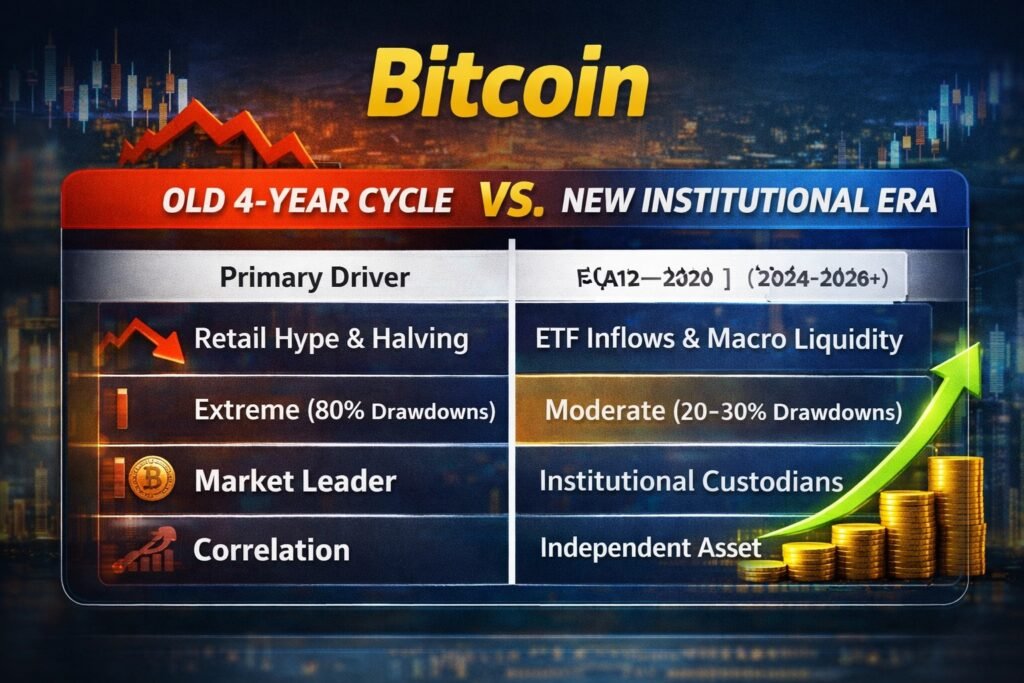
| Feature | The Old 4-Year Cycle (Past) | The New Institutional Era (2026) |
| Volatility | 80% Drawdowns | 20-30% Drawdowns |
| Main Buyer | Individual Retail Traders | Pension Funds & ETFs |
| Market Driver | Supply Shock (Halving) | Demand Shock (Inflows) |
| Price Action | Parabolic Spikes / Vertical Drops | Steady, Stair-Step Growth |
| Correlation | Uncorrelated to Stocks | Highly Correlated to Liquidity (M2) |
- User Personal Insight:
- As the developer behind Bitfluxe, I’ve spent the last few years building financial tools and gold trackers, but 2026 has been the most eye-opening year yet. When I first started coding our Bitcoin to USD calculators, the 4-year cycle was our North Star; it was predictable, rhythmic, and almost mechanical. But while monitoring our site’s backend data and seeing how users interact with our historical simulators lately, I’ve noticed a massive shift. People aren’t just ‘flipping’ crypto anymore; they are using our tools to calculate long-term wealth preservation, much like our gold rate users do.
I remember testing our early algorithms during the 2022 crash—the volatility was wild. Fast forward to today, and the ‘Institutional Floor’ we discuss in this article isn’t just a theory; I see it in the steady, stair-step growth patterns on our live charts. Building a platform that bridges the gap between traditional gold assets and digital currency has shown me that the ‘Super-Cycle’ is driven by one thing: Trust. For the first time, Wall Street trusts Bitcoin as much as the retail ‘OGs’ do. My advice? Stop waiting for the perfect cycle entry. In this new era of permanent institutional demand, the best time to understand the market is always today.”
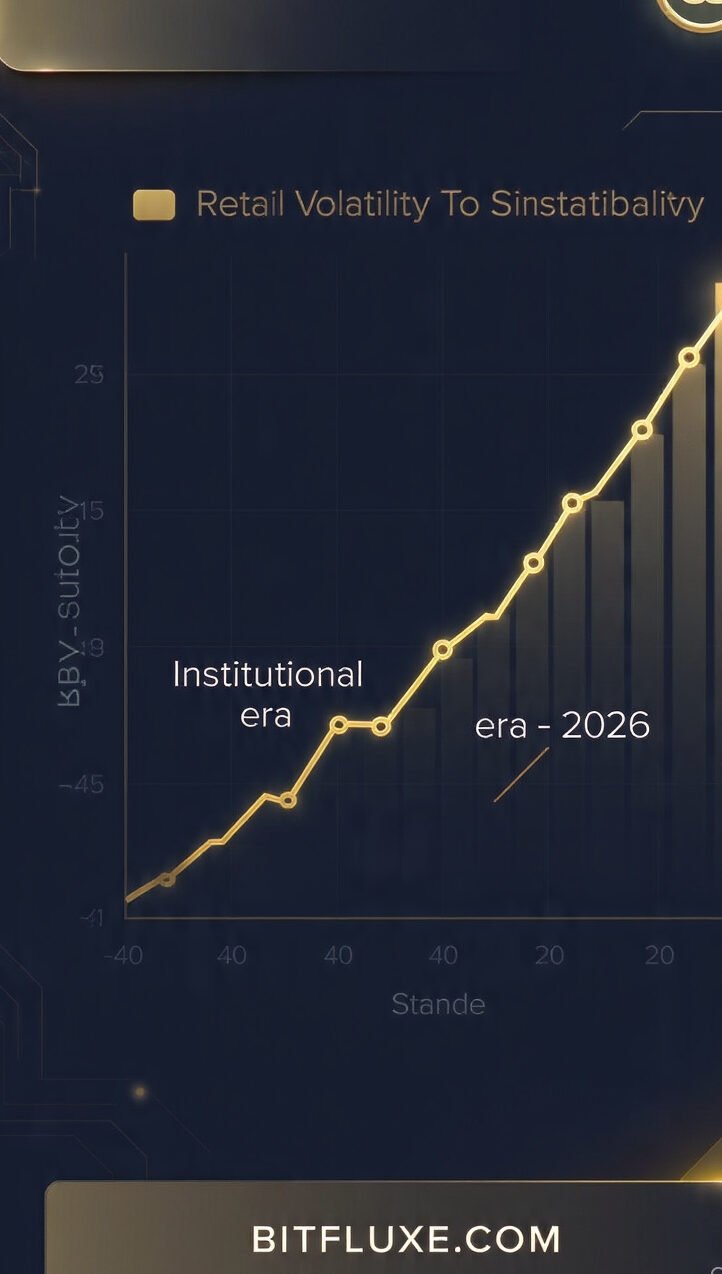
Featured Snippet Box: How do Spot ETFs change Bitcoin?
Spot ETFs allow trillions of dollars from traditional retirement accounts (401k) and pension funds to flow into Bitcoin. This provides a constant stream of “passive buying” that counteracts sell-offs, effectively dampening volatility and lengthening the growth phase of the market cycle.
FAQ
1. Is the Bitcoin 4-year cycle dead in 2026?
It’s not dead, but it has evolved. While the Halving still happens, its impact is smaller compared to the massive daily inflows from institutional ETFs. We are seeing a “smoothing” of the cycle.
2. Why didn’t Bitcoin crash after the 2024 Halving?
The 2024 Halving was the first time institutional demand was already at an all-time high before the supply cut. This “front-running” by Wall Street prevented the typical post-halving dump.
3. What is the “Institutional Floor” price?
The institutional floor is the price level where large funds (like BlackRock) have their largest buy orders. In 2026, analysts suggest this floor is sitting firmly between $65,000 and $72,000.
4. How does Bitcoin compare to Gold in 2026?
Bitcoin is increasingly being treated as “Digital Gold.” While physical Gold remains a hedge against total collapse, BTC is the preferred hedge for digital-native investors against fiat currency debasement.
5. Should I wait for a 50% correction to buy?
In the new era, a 50% correction would likely require a massive global systemic failure. Waiting for such a drop often leads to “missing the boat” as the price continues to grind higher.
6. Can governments still ban Bitcoin?
With major US banks and trillions in ETF assets tied to Bitcoin, a total ban is now politically and economically nearly impossible in the West.

Hi, I’mBaber! I’m a blogger and crypto enthusiast dedicated to uncovering the best trading key levels in the financial markets. My mission is to break down advanced technical analysis tools into easy-to-follow guides for traders worldwide. When I’m not analyzing charts on TradingView, I’m busy researching the latest in blockchain security and SEO strategy to bring you the most accurate market updates.
View full details on our Terms and Conditions page.