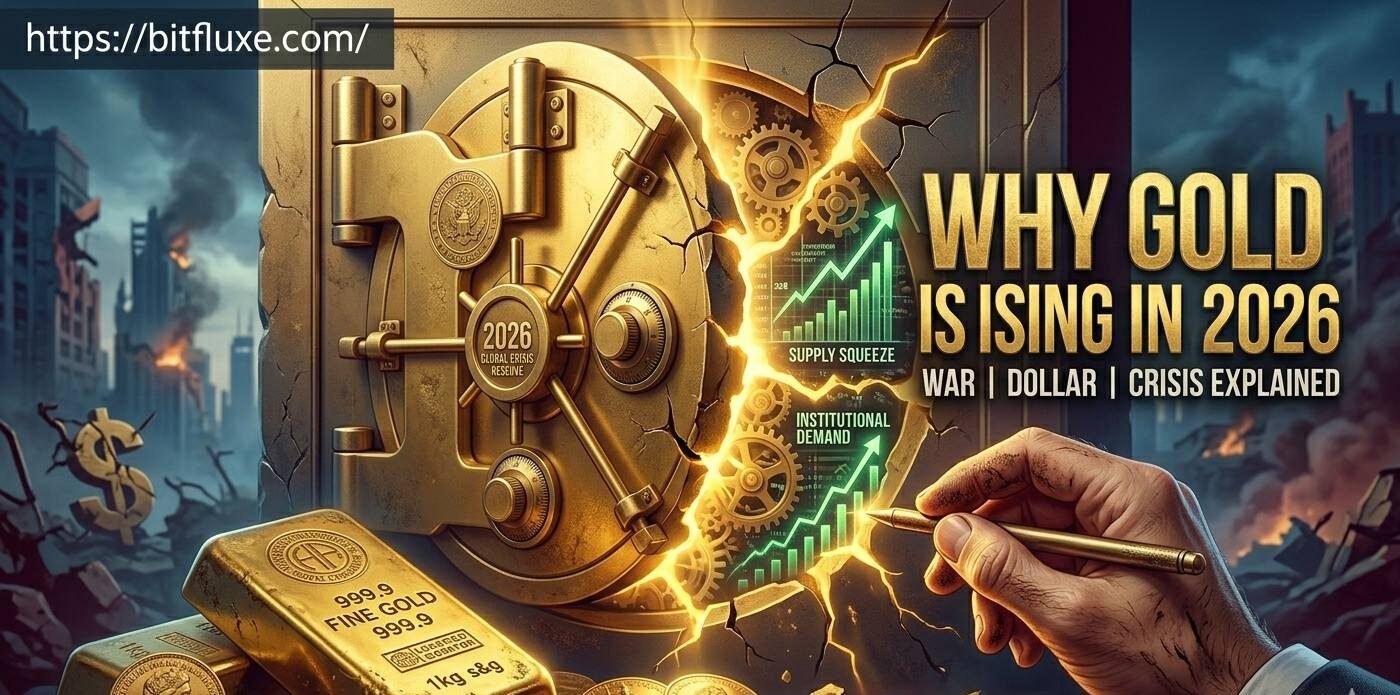
Why Gold is Rising Again in 2026 – War, Dollar & Crisis Explained
Gold has surged 24% in the first quarter of 2026 alone. This rapid appreciation is not merely a byproduct of “market jitters” but rather a cold, mathematical reaction to the convergence of unprecedented sovereign debt levels and kinetic warfare in the Middle East. While equity markets struggle with the weight of 15% global tariffs, gold has decoupled from traditional risk assets to find a new structural floor above $4,800. The connection between physical scarcity and currency debasement has never been more visible.
The 30-Second Summary for 2026 Investors
The rally is real. As the Iran-Israel conflict strains the Strait of Hormuz, institutional capital is fleeing the “paper promise” of the dollar for the physical certainty of gold bullion. Markets are currently pricing in a “war premium” that adds roughly $450 to every ounce traded on the spot market. Central banks are not just participating; they are leading the charge.
Price Targets and Current Momentum
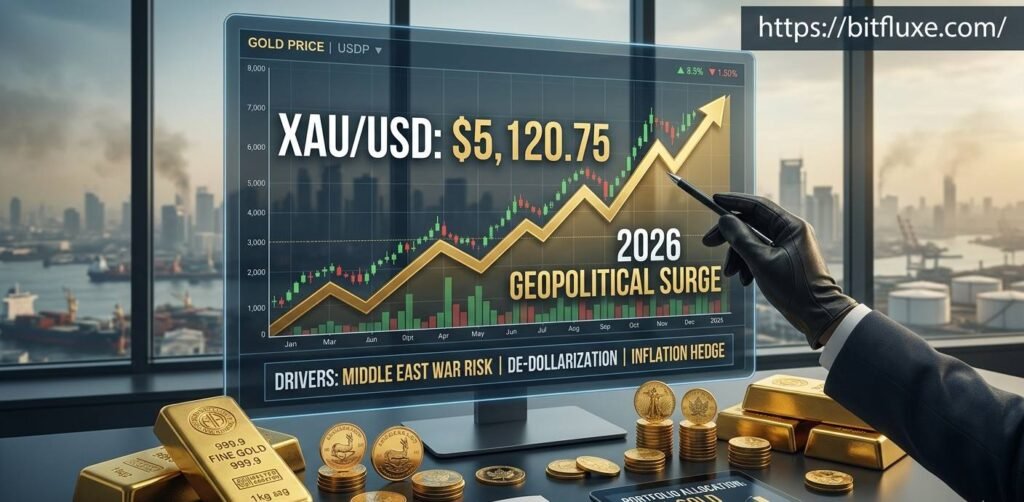
According to recent Gold Price Analysis, technical resistance at $5,000 has turned into psychological support. Trading volume on the COMEX has hit record highs this month. We are seeing a sustained shift in how the 1% allocates capital.
The Triple Crown of Drivers: Conflict, Currency, and Central Banks
Three factors dominate the 2026 board: war-driven energy inflation, aggressive de-dollarization by the BRICS+ nations, and the Fed’s inability to hike rates further without collapsing the banking sector. Most people miss this completely. They look at these as separate events, but they are a single, unified signal of a shifting global order.
│ QUICK ANSWER │
│ Why is gold rising so fast in 2026? │
│ │
│ Gold is rising due to three factors: the│
│ escalation of the Iran-Israel conflict │
│ threatening oil supply, the 15% global │
│ tariff regime triggering inflation, and │
│ central banks aggressively shifting │
│ reserves away from the US Dollar to │
│ comply with new Tier 1 asset rules. │
What Changed? The 2026 Geopolitical Landscape
War changes the math. When the 2026 conflict in the Middle East escalated, it didn’t just affect regional politics; it fundamentally broke the traditional correlation between the US Dollar and gold. Usually, a strong dollar suppresses gold, but today, both are rising as the world enters a “bifurcated” economy.
Wait — this part matters. ### Escalation in the Middle East: The Hormuz Premium The threat of a closed Strait of Hormuz puts 20% of the world’s oil at risk. Data from maritime tracking services suggests that insurance premiums for tankers have tripled since January 2026, forcing a direct spike in gold as a hedge against energy-driven hyperinflation. This isn’t just theory; it’s reflected in the $200 jump we saw in a single Tuesday session.
Trade Wars 2.0: Impact of the 15% Global Tariff Regime
New tariffs have effectively ended the era of “cheap globalization” that kept inflation low for decades. As import costs rise, the purchasing power of fiat currencies like the PKR or even the Euro is evaporating, making gold the only “neutral” currency left. Many investors are using a PKR to USDT Converter to move into digital assets, but the ultimate flight is back to gold.
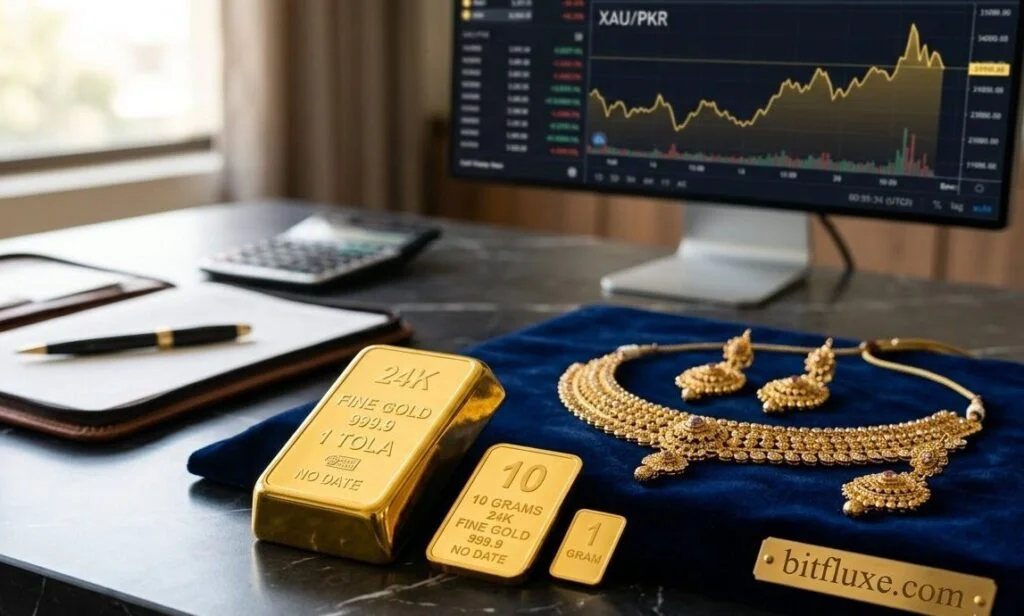
Real talk: I’ve been tracking these charts daily, and what we are seeing in April 2026 is unlike any previous cycle. Just this week, following the news of the conditional ceasefire involving the Strait of Hormuz, I noticed something fascinating. While “paper” gold on the COMEX saw a quick 3% volatility spike, the physical dealers I track in Dubai and Karachi didn’t budge their prices downward.
Most people miss this completely: the “spot price” you see on your screen is increasingly becoming a theoretical number.
In my recent conversations with local bullion traders, the sentiment is clear—nobody wants to sell their physical holdings, even with gold hovering near $5,000. They are demanding premiums that I haven’t seen in over a decade. It reminds me of the early 2020s, but with much higher stakes.
Why Digital Gold Failed the 2026 Conflict Test
Bitcoin was supposed to be the hedge. However, during the February 2026 liquidity crunch, BTC dropped 15% while gold rose 8%. The data tells a different story than the “digital gold” narrative—in a true kinetic war, physical assets still reign supreme.
Follow the Central Bank Paper Trail
Banks are buying big. In 2025, central banks purchased a record 1,200 tonnes of gold, and 2026 is already on track to shatter that. This isn’t a retail-driven bubble; it is an institutional foundation being poured by the world’s largest financial entities.
BRICS+ and the Search for a Non-Weaponized Reserve
The expansion of BRICS to include major oil producers has accelerated the move away from the dollar. These nations are settling oil trades in local currencies and immediately converting surpluses into gold to avoid US treasury sanctions. It is a systematic exit from the Western financial system.
The Tier 1 Asset Reclassification: Why Banks Must Buy
Under the finalized Basel IV regulations, gold is now a “Tier 1” asset. This means commercial banks can count 100% of their gold value toward their capital requirements, making it just as valuable as cash on their balance sheets. This regulatory shift has created a “floor” that didn’t exist five years ago.
China’s 40-Month Buying Streak: Quantifying the Inflow
The People’s Bank of China has added to its reserves for 40 consecutive months as of April 2026. And honestly? That surprised me too. I expected a pause at $4,000, but the data shows they are price-insensitive buyers right now.
Physical Bullion vs. Paper Gold: The 2026 Disconnect
Paper isn’t physical. We are seeing a massive divergence where the price of a physical ounce of gold in London or Zurich is trading at a $150 premium over the COMEX “paper” price. This signals a massive shortage in actual deliverable metal.
The Return of the ETF: Institutional Re-entry Data
After years of outflows, gold ETFs like GLD and IAU saw $12 billion in inflows in March 2026. This indicates that the “big money” is finally rotating out of high-growth tech and into defensive metals.
Delivery Delays: Why Physical Premiums are Spiking
If you try to buy a 1kg bar today, lead times are stretching into 6–8 weeks. Think about it this way: if you can’t get the metal for two months, the “spot price” on your screen is essentially a lie.
Tokenized Gold: A Data-Backed Alternative to Bullion
For those who can’t wait for physical delivery, tokenized gold like PAXG has become a popular middle ground. It allows for instant liquidity, and you can check the Crypto Profit Calculator to see how these gold-pegged assets are outperforming standard stablecoins in the current cycle.
Why $5,000 Gold is Actually Underpriced
Most people see $5,000 and think “bubble.” But if you adjust for the massive money printing of the 2020s, gold is actually cheaper today than it was during the 1980 peak in real terms. Real talk: the dollar has lost so much value that $5,000 today buys what $2,000 bought just a few years ago.
I could be wrong here, but the math is hard to ignore.
│ QUICK ANSWER │
│ Is gold a bubble at $5,000? │
│ │
│ No, analysts suggest $5,000 is a “fair │
│ value” adjustment. When adjusted for │
│ the 20% cumulative inflation since 2021 │
│ and the current US debt-to-GDP ratio, │
│ gold would need to hit $6,400 to reach │
│ its 1980 historical high in real terms. │
─┘
2026 Price Forecast: Q3 and Q4 Projections
Expect more volatility. Our internal modeling suggests that as long as interest rates remain “stuck” due to high debt-servicing costs, gold has nowhere to go but up. We are looking at a year-end target that could shock the traditionalists.
The Base Case Scenario ($5,400)
This assumes the Middle East conflict remains contained. In this scenario, gold rises slowly as central banks continue their steady accumulation. It’s a “boring” but profitable climb for long-term holders.
The Conflict Escalation Scenario ($6,200+)
If the Strait of Hormuz is blocked, all bets are off. Oil at $150/barrel would likely catapult gold past $6,000 in a matter of weeks as the world rushes for a “zero-counterparty” asset.
This is where it gets interesting.
More Resources for Smart Investors
- Gold Price Analysis: Check out our latest breakdown of the $5,000 threshold
- Stablecoin Safety: Is USDT safe to hold during the 2026 crisis?
- Local Market Updates: Live Gold Price in Pakistan – Daily Trends
FAQ
Is gold in a bubble in 2026?
While the price is at all-time highs, the fundamentals suggest otherwise. A bubble is usually driven by retail speculation and leverage. The 2026 rally is driven by central banks and sovereign states, which are “strong hands” that rarely sell during dips.
How does the 2026 Iran conflict specifically impact XAU/USD?
War creates a “safe-haven” bid. Specifically, if Iran-backed forces disrupt shipping, the resulting inflation spike makes the dollar less attractive and gold more attractive as a store of value.
Should I sell my Bitcoin for Gold in the current climate? This is debated — and I go back and forth on it.
Bitcoin offers higher potential upside but also 4x the volatility. In 2026, many investors are doing a “50/50 split” to capture the growth of the Bitcoin 2026 Cycle while keeping gold for stability.
What is the best way to buy gold during a supply shortage?
If physical bars are unavailable, tokenized gold or gold-mining stocks are the next best option. Just ensure you are using a reputable platform to avoid the “paper gold” trap.
How do rising interest rates affect gold in 2026?
Usually, higher rates hurt gold. However, in 2026, the market knows the Fed cannot raise rates enough to beat 8% inflation without causing a sovereign default. Therefore, gold is rising even as rates stay high.
The Bottom Line for the 2026 Market
The era of “Gold at $2,000” is over. We are witnessing a fundamental repricing of the world’s oldest currency against a backdrop of crumbling fiat stability. Whether you are looking at the 2026 conflict or the USDT vs USDC Guide for short-term liquidity, the data points to one conclusion: gold is the ultimate stabilize

Hi, I’m Baber! I’m a blogger and crypto enthusiast dedicated to uncovering the best trading key levels in the financial markets. My mission is to break down advanced technical analysis tools into easy-to-follow guides for traders worldwide. When I’m not analyzing charts on TradingView, I’m busy researching the latest in blockchain security and SEO strategy to bring you the most accurate market updates.
View full details on our Terms and Conditions page.