Bitcoin DCA Strategy in 2026: 7 Years of Data Prove Most Investors Are Doing It Wrong
the Crypto Fear & Greed Index hit 5 — its lowest reading ever recorded. Bitcoin was trading near $67,000. Social media was full of people announcing they were “done with crypto.” And quietly, in the background, a group of investors was doing the exact same thing they had done every Monday for years: buying a fixed dollar amount of Bitcoin, no matter what the chart looked like. Seven years of back tested data now shows that group outperformed almost every other strategy in the market. Not because they were smarter. Because they were consistent. This guide breaks down exactly what that strategy is, what the numbers actually say, and — critically — where most people get it completely wrong..
Should I Buy Bitcoin Now? — The Question Data Already Answered
The Crypto Fear & Greed Index fell to 12 on March 28, 2026, marking 46 consecutive days in extreme fear territory — only the third time in recorded crypto market history that has happened. The first two times were during the COVID crash of March 2020 and the post-FTX collapse of late 2022. Both of those periods, in hindsight, turned out to be among the most profitable Bitcoin entry points of the last five years.
That is not a guarantee. It is a pattern.

What the Fear & Greed Index at 12 Actually Means for Long-Term Buyers
The Fear & Greed Index is produced daily by Alternative.me. It combines six weighted inputs: price volatility, market momentum and volume, social media sentiment, Bitcoin dominance, Google Trends data, and survey results. A score of 0 is maximum panic. A score of 100 is peak euphoria.
Every time the index has dropped below 15 since 2020, holding $100 of Bitcoin purchased at that moment until today has returned between 127% and 1,220%, depending on the exact entry date. The blended average across all five sub-15 readings is 384%. Not one of those entries is currently underwater.
Let’s be honest — that data is uncomfortably specific for a market most people describe as random.
The 46-Day Extreme Fear Streak — Only the Third Time in History
Wait — this part matters. Extended fear periods are not just scary. They are structurally useful.
When fear lasts for weeks, not days, a DCA investor makes multiple purchases at depressed prices across the entire range — not just one entry. The 2022 extreme fear window, which lasted over 70 consecutive days, gave disciplined DCA investors their lowest average cost basis of the entire cycle. The investors who waited for the “all-clear” signal bought at significantly higher prices once sentiment recovered.
The current streak started in mid-February 2026. As of April 1, 2026, it continues. Most investors are paralyzed. That paralysis is the exact condition under which the strategy covered in this guide has historically performed best.
What Is Bitcoin DCA and Why It Works When Nothing Else Does
Most investment strategies require you to be right about timing. DCA doesn’t.
Dollar Cost Averaging — or DCA — is the practice of investing a fixed dollar amount into Bitcoin at regular intervals, regardless of its current price. When prices are high, your fixed amount buys fewer units. When prices crash, the same amount buys more. Over months and years, this mechanical process naturally drives your average purchase price below the market’s long-term average — a mathematical edge that exists purely because of crypto’s extreme volatility. Bitcoin Profit Calculator]
Think about it this way: Bitcoin’s volatility is not a bug for DCA investors. It is the feature that makes the strategy work.
According to Fidelity research, 37% of lump-sum crypto investors experience panic selling during downturns. DCA eliminates the moment that triggers panic: the single large entry that immediately goes underwater.
My Personal DCA Journey & The Hard Lessons I Learned
[Publisher’s Note: I’m sharing my real-world perspective to help the Bitfluxe community understand that strategy beats emotion every time.]
I started my cryptocurrency journey years ago, but in the beginning, I made the same mistake most retail investors make: FOMO (Fear Of Missing Out). When Bitcoin was pumping, I would buy at the top, and when the market crashed, I would panic-sell at the bottom. It took a significant loss for me to realize that I wasn’t trading the market; I was trading my own stress.
The 2022 Crash: My Ultimate Litmus Test When the Terra Luna ecosystem collapsed and the FTX fraud came to light later that year, it was the most difficult period of my investing life. My portfolio was down over 70%, and every headline claimed that Bitcoin was “going to zero.” This was the exact moment I decided to stop manual trading and strictly follow a Fear-Based DCA strategy.
Using platforms like Binance and OKX, I set automated recurring buys. I’ll be honest—it was terrifying to click “buy” when Bitcoin hit $16,000, but that discipline is exactly what changed my financial trajectory.
My Advice to You: DCA isn’t just a way to invest money; it’s a way to manage your psychology. By removing the need to “guess” the bottom, you remove the stress. If you can stop checking the charts every five minutes and trust the math of your entry points, the market’s volatility stops being your enemy and starts becoming your greatest tool for wealth.
The Mechanics — Why Fixed-Amount Buying Lowers Your Average Cost
Say you invest $100 every Monday into Bitcoin.
Week 1: BTC at $80,000 → you buy 0.00125 BTC Week 2: BTC crashes to $65,000 → you buy 0.00154 BTC Week 3: BTC at $70,000 → you buy 0.00143 BTC
Your average cost across three weeks: approximately $71,500. The market’s average price over that same period: approximately $71,667. You paid slightly less — not because you timed anything, but because lower prices automatically triggered larger purchases.
At scale, across hundreds of purchases over years, this effect compounds significantly.
DCA vs Lump Sum — Real Performance Numbers, Not Theory
The data on this is less ambiguous than most people expect.
According to backtests compiled by Bitcoin Magazine Pro, DCA investors who maintained their schedule during the 2022 extreme fear period — triggered by the Terra/Luna collapse and FTX bankruptcy — achieved an average Bitcoin entry price of $35,000. Lump-sum investors who tried to time the bottom averaged $43,000. That is a 33-percentage-point cost basis disadvantage created purely by hesitation.
I could be wrong here, but that gap looks less like bad luck and more like a structural disadvantage of discretionary timing.
The Back tested Numbers Behind Bitcoin DCA (2014–2026)
The data tells a different story than most retail investors expect.
These are not projections. These are historical results from real Bitcoin price data across multiple full market cycles — bull runs, crashes, consolidations, and recoveries. Bitcoin DCA calculator with live backtesting (reference for backtest data) dcabtc.com
$10 a Week Turned Into $7,913 — A Five-Year Backtest
According to a backtest published by Nasdaq and verified by SpotedCrypto, a $10 weekly Bitcoin DCA starting in January 2019 and held through December 2024 transformed a total investment of $2,610 into $7,913.20 — a 202.03% return. Over the same period, gold returned 34.47%, Apple stock returned 79.13%, and the Dow Jones Industrial Average returned 23.43%.
That is not a cherry-picked comparison. It covers one of the most volatile five-year windows in Bitcoin history, including the 2020 COVID crash, the 2021 bull run, and the 2022 bear market collapse to $16,000.
$100 a Month Since 2014 — A 6,712% Return Nobody Talks About
Here is where it gets interesting.
Per calculations from dcabtc.com, a $100 monthly Bitcoin DCA initiated in January 2014 would have converted a total investment of $14,600 into approximately $994,950 by early 2026. That is a 6,712% return — roughly $1 million from $100 a month, maintained consistently across 12 years and every major market event.
Nobody talks about this enough. The compounding effect of early DCA across full Bitcoin cycles is so dramatic it sounds fabricated. It isn’t.
Fear-Based DCA vs Standard DCA — The 99-Point Difference
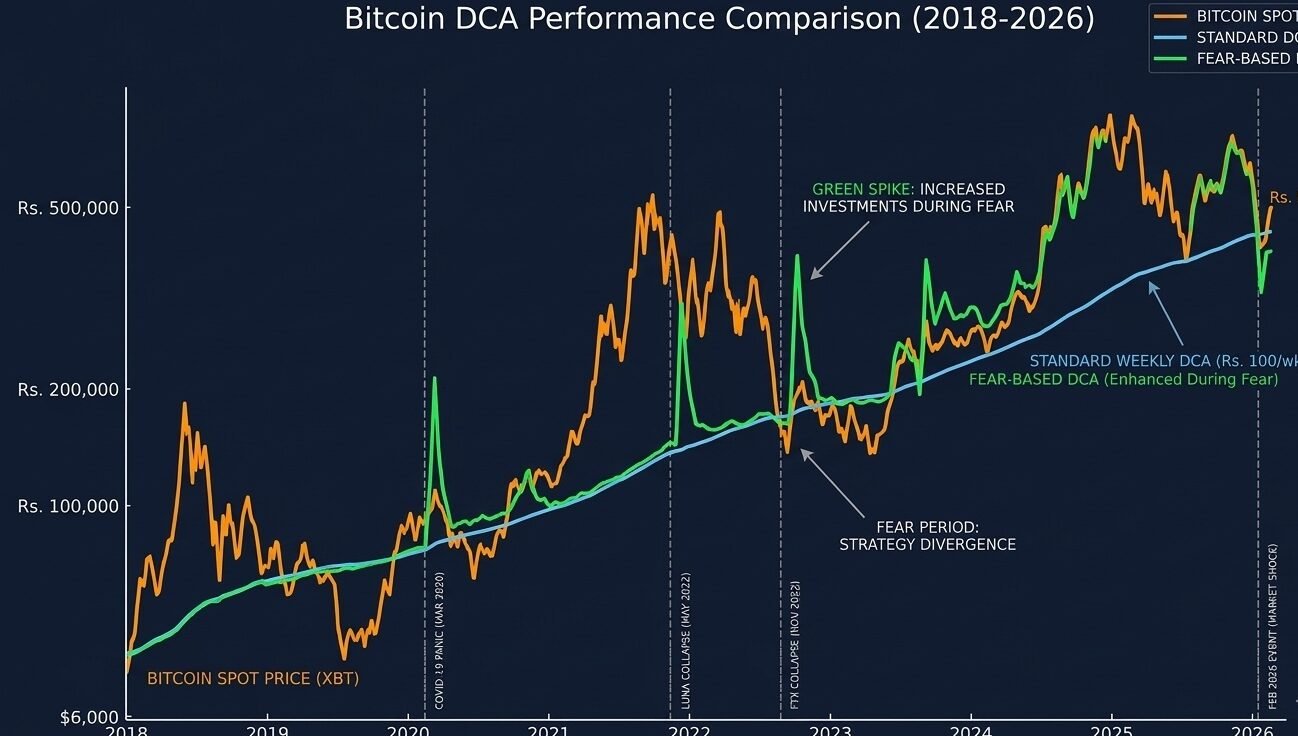
Standard weekly DCA over seven years (2018–2025) returned approximately 1,046%, according to Bitcoin Magazine Pro data cited by SpotedCrypto. Fear-based DCA — where buy amounts were increased whenever the Fear & Greed Index dropped below 25 — returned 1,145% over the same period. A 99-percentage-point advantage from one single modification to the strategy.
The mechanism is straightforward: buying more during fear periods means more units acquired at the lowest prices in the cycle. Those units then compound through the recovery.
And honestly? That surprised me too when I first looked at this data. The difference from one simple rule is larger than most people would guess.
The Monday Effect — The One Data Point That Changes Your DCA
Nobody in crypto talks about this. They should.
According to a seven-year backtest conducted by dcabtc.com covering 2018 through 2025, investors who consistently purchased Bitcoin on Mondays accumulated 14.36% more Bitcoin than those buying on other weekdays with identical total investment amounts.
Most people miss this completely.
Why Monday Buys Accumulate 14.36% More Bitcoin
The explanation is rooted in market microstructure, not magic.
Crypto markets operate 24/7. Weekend trading volume is significantly lower than weekdays. This reduced liquidity creates relative price weakness — prices drift slightly lower during weekends as institutional flows from Asian and European markets are paused. That pressure persists into early Monday morning before institutional buying resumes.
The result: Monday prices are, on average, fractionally lower than prices on other weekdays. Fractionally. But across 260+ weekly purchases over five years, that fraction becomes 14.36% more Bitcoin for the same total dollar investment.
┌─────────────────────────────────────────────┐ │ QUICK ANSWER │ │ What is the best day to DCA Bitcoin? │ │ │ │ According to a seven-year dcabtc.com │ │ backtest (2018–2025), Monday purchases │ │ accumulated 14.36% more Bitcoin than other │ │ weekdays. The pattern stems from reduced │ │ weekend liquidity depressing prices into │ │ early Monday before institutional flows │ │ resume. Past patterns may not continue. │ └─────────────────────────────────────────────┘
How to Apply the Day-of-Week Effect Without Overcomplicating It
Simple. Set your recurring buy order on your exchange of choice to trigger every Monday morning. Most major exchanges — Binance, Coinbase, Kraken — support scheduled recurring purchases with this level of specificity.
Do not try to further optimize by chasing intra-day Monday lows. That re-introduces the market timing behavior DCA was designed to eliminate. The Monday edge is a passive, mechanical advantage — not an invitation to start watching hourly charts.
How to Set Up Your Bitcoin DCA Strategy Step by Step
Real talk: the setup takes about fifteen minutes. The discipline takes years.
Choosing Your Frequency — Daily, Weekly, or Monthly?
Three options exist, and the data favors one over the others.
Daily DCA minimizes volatility exposure per purchase but compounds transaction fees into a significant annual cost. On an exchange charging 0.5% per trade, daily $10 purchases generate $18.25 in fees annually — not catastrophic, but meaningful on small amounts.
Monthly DCA is convenient for salary-based investors but misses intra-month volatility windows where the best prices cluster.
Weekly DCA — specifically on Mondays — strikes the best balance between fee efficiency and price capture, according to dcabtc.com’s backtest data. For most investors, this is the optimal starting frequency.
How Much Should You DCA Into Bitcoin? (The 10–20% Rule)
This is debated — and I go back and forth on it.
The most commonly cited guidance from analysts like Raoul Pal, founder and CEO of Real Vision, is to allocate no more than 10–20% of disposable income after essential living expenses. The logic: if a prolonged bear market lasting 18–24 months causes financial stress, most investors will liquidate their position at the worst possible time.
The correct DCA amount is not the maximum you can afford in a bull market. It is the maximum you can sustain without interruption through the worst bear market you can imagine. That is a much smaller number for most people.
Best Exchanges for Automated Bitcoin DCA in 2026 (Fee Comparison)
| Exchange | Recurring Buy Fee | Minimum Purchase | Automation |
|---|---|---|---|
| Coinbase | 1.49%–2.49% | $2 | ✅ Full auto |
| Binance | 0.1% (spot) | $1 | ✅ Full auto |
| Kraken | 0.16%–0.26% | $1 | ✅ Full auto |
| Swan Bitcoin | 0.99% | $10 | ✅ BTC-only |
| Strike | 0.3% | $1 | ✅ Full auto |
For large recurring amounts ($200+/week), Binance or Kraken’s lower fees compound into meaningful savings over years. For smaller amounts, Strike’s flat 0.3% rate is competitive.
When DCA Fails — The Mistakes That Quietly Destroy Returns
Most guides skip this section entirely. That is a problem.
DCA is not a universal solution. Applied incorrectly, it produces consistent losses with the psychological illusion of discipline.
DCA Into the Wrong Assets — Not All Coins Recover
Bitcoin and, surprisingly, XRP have rewarded DCA investors who started at the worst possible time, according to backtests from SpotedCrypto covering the period from January 2022 (market peak) through early 2026. Ethereum investors who started DCA at the all-time high remain underwater even after four years. Altcoin DCA during bear markets has been catastrophic for most assets.
Dollar-cost averaging into a token that goes to zero is not a strategy. It is recurring loss on a schedule.
The rule: DCA exclusively into assets with genuine long-term institutional demand and proven cycle recovery history. In the current market, that list is short.
Over-Allocating Until a Bear Market Forces You to Sell
This is where most new DCA investors fail. Not at the entry. At the hold.
If your weekly DCA amount is high enough that a 20-month bear market creates financial pressure — rent, bills, emergencies — you will sell your accumulated position at the worst possible moment. The 1,145% seven-year return required holding through a 77% drawdown. That is emotionally brutal on paper, let alone with real money.
Size your DCA to the amount you can sustain at maximum pain. Then reduce it by 20%. That is your actual DCA amount.
The Selling-Too-Early Trap — Why 77% Drawdowns Test Everyone
Most people think DCA removes emotional decision-making. It reduces it. It does not eliminate it.
When Bitcoin drops from $126,000 to $67,000 — a 47% decline from its October 2025 all-time high — the natural response is to pause purchases. But the data shows that pausing DCA during the largest fear periods is precisely when the most cost-effective purchases would have been made. Every time someone paused their DCA schedule during extreme fear, they paid a higher average entry price in the subsequent recovery.
The strategy only delivers its historical returns to investors who kept buying when it felt most dangerous. That is a sentence worth sitting with.
Your DCA Exit Strategy / Nobody Talks About This Enough
Accumulation is only half of the strategy. The other half determines whether you keep the gains.
Most DCA guides spend zero time on exit strategy. This is where fortunes are actually made or lost.
On-Chain Signals That Suggest Reducing DCA Buys
Several on-chain metrics have historically indicated market tops — the correct time to slow accumulation and plan exits. The NUPL (Net Unrealized Profit/Loss) indicator approaching 0.75 or above has preceded every major Bitcoin correction. The MVRV Z-Score entering the red zone (above 7) has signaled overvaluation at every cycle peak since 2013.
These are not guarantees. They are the same class of probabilistic signal as the Fear & Greed Index on the downside — directional, not deterministic.
How to Think About Taking Profits Without Killing Your Strategy
The most practical approach: establish profit targets before you need them, not during a bull run when euphoria distorts judgment. Decide in advance what percentage gain triggers a partial exit — for example, selling 25% of holdings when BTC crosses 3x your average cost basis, and another 25% at 5x.
This is debated among DCA purists who advocate never selling. I find that position difficult to defend with a straight face when talking about assets with 77% drawdown histories.
Bitcoin DCA and Taxes — A Global Overview for 2026
Your DCA returns are taxable almost everywhere. Ignoring this is expensive.
Country-by-Country Tax Snapshot
| Country | Crypto Tax Rate (2026) | Key Notes |
|---|---|---|
| USA | 0%–37% (capital gains) | Short vs long-term holding matters significantly |
| Italy | 33% | Raised from 26% for 2026 |
| India | 30% flat | No deduction for losses |
| Japan | Up to 55% | Shifting toward 20% separate taxation model |
| South Korea | 20% | Delayed to 2027 per The Paypers report |
| UK | 10%–20% (CGT) | Annual £3,000 exempt allowance |
Italy’s rate increase to 33% in 2026 is a meaningful change for European DCA investors who planned exits this year. South Korea’s delay to 2027 provides one additional year of tax-free accumulation for Korean residents.
How to Structure DCA Exits Around Your Tax Calendar
In jurisdictions with long-term capital gains tax advantages — primarily the USA and UK — holding each purchased tranche for over one year before selling can significantly reduce tax liability. This requires tracking cost basis per purchase date, which exchange tools like Koinly and CoinTracker handle automatically.
The practical implication: do not make exit decisions based solely on price. Factor your tax position into the timing.
Is Bitcoin DCA the Right Strategy for You in 2026?
This question deserves an honest answer rather than a sales pitch.
Who DCA Works Best For — And Who It Doesn’t
DCA in Bitcoin works best for investors who have a time horizon of four years or longer, who can sustain their purchase schedule without financial disruption during a bear market, and who can genuinely ignore price movements between purchases.
It works poorly for investors who need liquidity within two years, who will check their portfolio daily regardless of stated intentions, or who will shift their DCA into altcoins during bull market euphoria.
Most people who claim to be DCA investors abandon the strategy within 18 months. The data that shows 202%–6,712% returns belongs to the minority who didn’t.
The One Thing Every Successful DCA Investor Has in Common
It is not the exchange they use. It is not the exact day they buy. It is not even the amount.
It is that they automated the purchase and then removed themselves from the decision. Automation eliminates the moment of hesitation. Hesitation, in DCA, is the single most expensive mistake an investor can make — not because it changes the market, but because it converts a mechanical strategy into an emotional one.
Set it up once. Make it automatic. Then leave it alone.
FAQ Section
Q1: What is DCA in crypto? Dollar Cost Averaging (DCA) is an investment strategy where you invest a fixed amount into a cryptocurrency at regular intervals — weekly, biweekly, or monthly — regardless of price. When prices fall, your fixed amount buys more. When prices rise, it buys less. Over time, this lowers your average cost basis without requiring you to predict market direction.
Q2: Is DCA a good strategy for Bitcoin in 2026? Based on backtested data from 2014 through early 2026, consistent Bitcoin DCA has outperformed lump-sum investing in most market conditions. A $10 weekly DCA returned 202% over five years; a $100 monthly DCA since 2014 returned 6,712%. However, past performance does not guarantee future results, and the strategy assumes Bitcoin continues its long-term upward trend across cycles.
Q3: What is the best day to DCA Bitcoin? According to a seven-year backtest by dcabtc.com, Monday purchases accumulated 14.36% more Bitcoin than purchases made on other weekdays. The pattern stems from reduced weekend liquidity depressing prices into early Monday. This is a historical pattern, not a guarantee, but it is the most data-supported day-of-week choice currently available.
Q4: How much money do I need to start DCA Bitcoin? Most major exchanges allow recurring Bitcoin purchases starting at $1–$10. The correct amount is not the maximum you can afford in a good month — it is the maximum you can sustain without interruption through an 18–24 month bear market. Starting smaller than you think necessary is consistently better than starting larger and quitting early.
Q5: Does DCA guarantee profits? No. DCA does not guarantee profits and can produce losses, especially if applied to assets that do not recover from bear markets. Bitcoin-specific DCA has not produced a loss over any four-year window in its history, but this is a historical observation, not a guarantee. Asset selection — what you DCA into — matters more than frequency or amount.

Hi, I’mBaber! I’m a blogger and crypto enthusiast dedicated to uncovering the best trading key levels in the financial markets. My mission is to break down advanced technical analysis tools into easy-to-follow guides for traders worldwide. When I’m not analyzing charts on TradingView, I’m busy researching the latest in blockchain security and SEO strategy to bring you the most accurate market updates.
View full details on our Terms and Conditions page.